
Look Forward – Spring 2026 – Issue 189
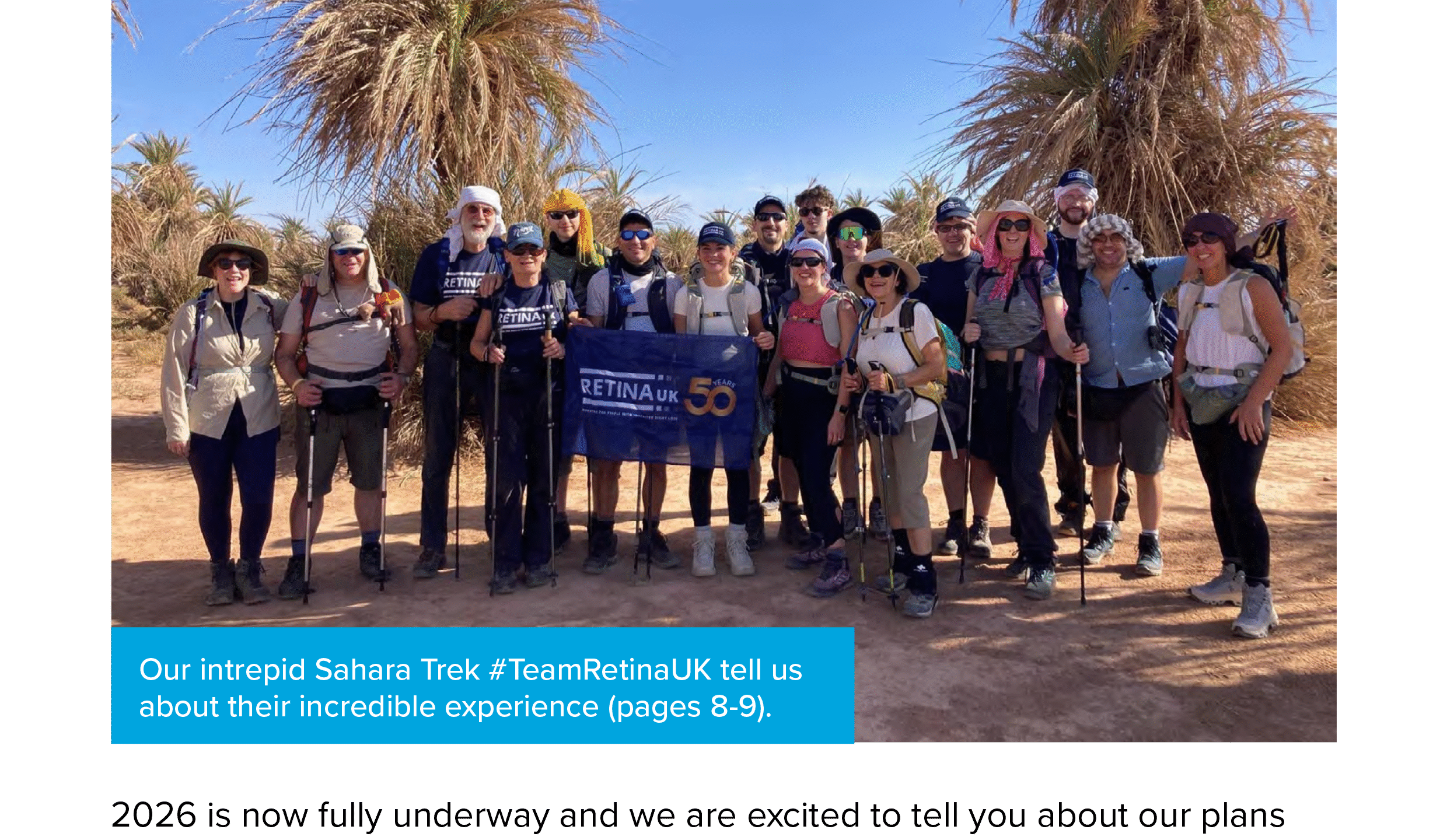
Inside: Our intrepid Sahara Trek #TeamRetinaUK tell us about their incredible experience. 2026 is now fully underway and we are excited to tell you about our plans. Could you take part in a challenge event or volunteer to do a bucket collection in London for Retina UK?
This edition includes our regular research news round-up and an interview with our wonderful volunteers Suzanne and Anne who are based in the South-West of the country.
Do let us know what you think of Look Forward. We are always pleased to receive any feedback. Email the Editor, Jane, on [email protected].
Download Look Forward, Spring 2026:
- Accessible PDF PDF file | 2 MB
- Word plain text Word document | 59 KB
Newsletter content
Welcome to the first edition of Look Forward in 2026.
I want to begin by offering my sincere thanks to everyone who supported our BBC Lifeline and Big Give appeals at the end of 2025. Your generosity made an extraordinary difference. Thanks to you, the Big Give raised a record-breaking £113,638, and the BBC Lifeline appeal raised £14,881 (both including Gift Aid), while also helping to shine a UK-wide spotlight on inherited sight loss. These results simply wouldn’t have been possible without you.
We are incredibly proud that our Scientific and Medical Advisory Board Chair, Professor Tara Moore, has been awarded an OBE in the New Years Honors List 2026. We are very grateful for her continued input and support of our research funding programme at Retina UK.
Looking ahead, we are already busy planning our 2026 Professionals’ and Annual Conferences. Sign up for alerts at RetinaUK.org.uk/annual-conf or RetinaUK.org.uk/prof-conf.
We are also developing an exciting programme of podcasts and webinars for 2026, sharing expert insight and lived experience from across our community. Recordings from previous sessions are available at RetinaUK.org.uk/resources.
Finally, I would like to mark the passing of a remarkable figure in inherited retinal disease research. Professor Alan Wright, who died on 20 December, made a truly historic contribution. In 1984, alongside Dr Shomi Bhattacharya, he identified a marker indicating the position of an RP gene – a breakthrough that paved the way for decades of progress. Every advance since has been built on that foundation. Our thoughts are with his family, friends and colleagues.
Thank you for continuing to stand with Retina UK. Your support, commitment and belief in a better future for people affected by inherited sight loss gives us hope and momentum every day. Together, we will keep driving progress forward.
Events close to home
We are increasing the number of regional events around the UK and it would be useful for us to be able to tell you what’s happening near you. There are a significant number of records on our database where an address hasn’t been recorded, which means that we can’t tell you when something is happening in your area. If you are willing to share this information (and you don’t currently receive hard copy mail from us) please complete the form at RetinaUK.org.uk/mailing-list. If you do not want to receive anything from us by mail, please tick the preferences and consent box for no post.
Articles for the Blind
Did you know that we may be able to post this newsletter and other mail to you free of charge under Royal Mail’s Articles for the Blind (AFB) scheme?
All you need do is notify us that you are blind or visually impaired and you are happy for us to send post to you under this scheme. Please email [email protected] or call us on 01280 821334 and ask us to record this information. If you already receive this newsletter from us marked Articles for the Blind, there is no need to do anything.
Freepost
The Freepost address operated by Retina UK is designed to allow our community to send items in support of the charity. However, you can choose to reduce our costs by affixing stamps to cover postage costs. This small change could save the charity more than £650 per year!
Cheques
We recognise that for our community, cheques are a safe and convenient way in which to support Retina UK. However, UK banks have been gradually phasing out cheques in favour of digital payments and our bank (Lloyds) stopped accepting cheques via banking hubs and in Post Offices from January 2026.
If you are able to support Retina UK by making your payment online RetinaUK.org.uk/donate, or by telephoning our office on 01280 815900 so we can process an online payment on your behalf, we would appreciate it. If it is more convenient to make a bank transfer, we can provide our bank details over the phone. However, if you would prefer to continue to make your payment by cheque, please do so, but be aware that it may take longer to process than in the past.
It’s time to reflect, celebrate and look to the future… and you’re invited. We are hosting a gala dinner on Saturday 24 October 2026 at the world-famous London Hilton on Park Lane and we would love you to join us for a truly unforgettable evening, as we celebrate the culmination of our 50th anniversary year.
The event will bring our community and supporters together to make new connections and raise vital funds and awareness for our work. We anticipate a glamorous and impactful evening with the inherited sight loss community at its heart. Join us as we celebrate 50 years of ground-breaking work in supporting people affected by inherited sight loss.
With spectacular performances, unforgettable moments, exquisite food and an enviable guest list, our gala dinner is set to be an unmissable evening of fun and fundraising.
You can purchase your tickets or tables and find out more at RetinaUK.org.uk/gala-dinner or by calling 01280 815900.
“I have been a long-term volunteer for Retina UK and I would not miss this special opportunity to be a part of a momentous night for the charity.”
Since 1976, we have been at the forefront of funding vital medical research, providing essential information and support, and building a community of hope for thousands of families across the UK. This milestone celebration brings together researchers, supporters, families, and friends to honour our remarkable journey and look forward to the next chapter in our goal to accelerate the search for treatments for inherited retinal conditions.
Our hard work continues at pace and our gala dinner will be the start of our next chapter. We would love you to be a part of this truly momentous occasion and we look forward to you joining us in London.
If you would like to explore sponsorship opportunities or have any further queries regarding the event, please contact our Head of Income Generation, James Clarke, on [email protected] or 07736 925174.
In the last edition of Look Forward we told you that our Gala Dinner would be taking place on 6 June. As you have read, the date has changed and it is now taking place on Saturday 24 October. Please accept our apologies for any confusion this may cause.
Individual ticket: £200
Table of 10: £2,000
- Complimentary drink on arrival
- 3-course dinner
- Half a bottle of wine per person
- Live entertainment
- Special guest performances
- Inspiring speeches
- Valued contribution to Retina UK.
Promising results for Stargardt disease
Belite Bio has reported encouraging results from its global Phase 3 trial of Tinlarebant, an oral once-daily tablet designed to slow vision loss in Stargardt disease by reducing harmful toxin buildup in the retina.
Stargardt disease is usually caused by mutations in the ABCA4 gene, which normally produces a protein in photoreceptor cells that clears toxic byproducts of the visual cycle. Without this protein, toxins accumulate on the macula, destroying photoreceptors and impairing central vision. These toxins depend on vitamin A being transported from the eye to the liver. Tinlarebant works by lowering levels of RBP4. By reducing RBP4, less vitamin A reaches the eye, decreasing toxin production and potentially protecting retinal tissue.
The study enrolled 104 patients aged 12–20 and showed that Tinlarebant significantly reduced the growth rate of diseased areas.
Although the trial did not show immediate improvements in visual acuity over the 24-month period, due to the short trial length and slow progression of Stargardt’s, slowing atrophic lesion growth is expected to translate into slower sight loss over time. Belite Bio plans to monitor participants to confirm long-term benefits.
Belite Bio has also announced that enrolment in the phase 2/3 clinical trial of Tinlarebant is complete. 60 adolescents aged 12-20 with genetically confirmed Stargardt disease have been enrolled across Japan, the United States, and the United Kingdom
The next BEST thing!
Opus Genetics has reached an important clinical milestone by dosing the first patient in its Phase 1/2 trial of OPGx-BEST1, an investigational gene therapy for Best Vitelliform Macular Dystrophy (Best disease). Best disease is caused by mutations in the BEST1 gene, which disrupts production of the bestrophin-1 protein in retinal pigment epithelium (RPE) cells, leading to toxin buildup and progressive vision loss.
OPGx-BEST1 is an adeno-associated viral vector (AAV) gene therapy, delivered via a one-time subretinal injection. It aims to introduce a healthy copy of the BEST1 gene into the RPE, allowing for the production of the bestrophin-1 protein. This approach aims to retore normal function of the RPE cells so that they can provide proper support to light-sensing photoreceptors as intended.
The Phase 1/2 study will evaluate the safety, tolerability and early efficacy of a single injection of OPGx-BEST1 into one eye of adults with Best disease and explore the most appropriate dose for further development. Opus Genetics aim to obtain preliminary data from a Phase 1/2 study by the first quarter of 2026.
Flipping the switch on RP
SparingVision has reached a major milestone in retinitis pigmentosa (RP) research by dosing the first patients in the NYRVANA Phase 1 trial of SPVN20, a gene-agnostic therapy for advanced RP.
SPVN20 is an AAV gene therapy, delivered via a single intravitreal injection, designed to target dormant cone photoreceptors (light-sensing cells in the retina that have lost their ability to respond to light but remain alive). The therapy aims to reactivate these cones, potentially improving visual acuity and colour vision.
SparingVision are also developing SPVN06, intended to slow disease progression in rod-cone dystrophies, and hope to combine SPVN20 and SPVN06 into one therapy in the future for multiple disease stages.
The trial began in Belgium, with plans to expand recruitment to France and Ireland, enrolling adults 18+ with advanced RP who retain dormant cones.
Genes aren’t destiny
A new study published in The American Journal of Human Genetics has challenged long-held assumptions about how genetic variants linked to IRDs actually translate into disease.
IRD-linked genetic variants are more common in the general population than previously believed, with estimates suggesting 0.7-2.1% of people carry such genotypes. However, only about 9-28% of individuals with these high-risk genetic variants actually show clinical signs of IRDs.
The appearance of symptoms didn’t correlate with age, smoking, socioeconomic status or other common risk factors, suggesting that additional genetic or environmental modifiers influence whether disease develops. This finding reframes how we think about predictive genetic testing and IRD risk. A pathogenic variant doesn’t always lead to disease and understanding why some carriers stay healthy points towards a new era of IRD research that could unlock new therapeutic targets.
The full content for these articles can be found at RetinaUK.org.uk/research-news.
You can keep up to date with further developments via our e-news, Look Forward newsletter, social media, website, webinars and podcasts.
In November 2025 Retina UK led a group of 16 intrepid explorers on a trek across the Sahara desert. We spoke to two of them about their experience.
James describes the Sahara Trek as something that felt almost impossible after his diagnosis of retinitis pigmentosa (RP) in 2018, but he was determined to live fully and push himself beyond what he thought was possible.
Like many trekkers, James had preconceptions about the desert. “I was expecting snakes, scorpions and something straight out of Indiana Jones,” he laughs. “But I didn’t see any of that. Instead, there were gerbils, scarab beetles, stick insects and the occasional crow.” What surprised him most, though, was how manageable the whole experience felt thanks to the support in place.
The trek proved to be transformative. James described the silence of the desert at sunrise and sunset as “unforgettable – vast landscapes, no buildings, no aircraft, no noise”. For someone with RP, the absence of light pollution meant he could see stars in a way he hadn’t been able to before. The trek brought him deep friendships, renewed confidence, and a sense of achievement that continues to shape his life.
But the trek was also a place where James confronted a reality many people with inherited retinal conditions face: the uncertainty of genetic testing. James’s own genetic diagnosis came relatively quickly through Oxford Eye Hospital – blood tests, a confirmed gene within three months. Others on the trek are still waiting, including Ryan, has been waiting over a year for results.
Lisa joined the same trek for reasons that were both personal and profoundly hopeful. Lisa’s daughter, Saffie, was diagnosed in August 2024 with Leber congenital amaurosis (LCA), a severe inherited retinal condition caused by the RPE65 gene. Without treatment, she would lose her sight by her mid-twenties. Like many families, Lisa and her husband had never heard of inherited retinal dystrophies until it entered their lives.
Saffie was fortunate to be eligible for Luxturna, the only approved treatment for this condition. After two operations in 2025, Lisa describes the results as nothing short of miraculous. Saffie, who was completely night blind, can now run confidently in the dark. She can see steps, navigate spaces independently, and participate fully in life like other children her age. Lisa still gets emotional when she recalls watching her daughter’s face light up after the first surgery. She describes it as a “magic wand moment”.
Lisa and her husband felt strongly they couldn’t benefit from this treatment without giving back. They set up fundraising efforts and, with the help of their extended family and community, raised over £21,000. Their commitment didn’t stop there. For them, supporting Retina UK is now a lifelong promise.
The trek brought James and Lisa together with other trekkers, each with their own story of sight loss, hope, and resilience. For Lisa, the trek was initially daunting. She worried about logistics, and the reality of living without home comforts for a week. But she found the experience life-changing – full of laughter, shared stories, and deep connection. The final evening, when the group watched the sunset from a sand dune, remains her favourite memory.
For them both, the trek was a way to give back and to connect with people whose lives are affected by inherited sight loss. The Sahara became more than a challenge – it became a community.
Their stories reveal the full journey of inherited retinal conditions – waiting, uncertainty, answers, and the hope that research brings. They also show why Retina UK is so important: it supports families through diagnosis, genetic testing, treatment, research and peer connection.
As James said, and Lisa echoed through her story, the trek is not just about walking across a desert. It’s about walking together – towards hope, towards discovery, and towards a future where more people can benefit from life-changing treatments.
Inspired by James and Lisa? Could you plan a Spring Skydive or take part in 5K a day in May? Choose your challenge by visiting the Retina UK website: RetinaUK.org.uk/events.
For people living with inherited retinal conditions, finding others who understand can make a profound difference. In the South-West, volunteers Suzanne and Anne are helping to create those connections – offering support, understanding and a strong sense of community across a wide and largely rural area. Although they live some distance apart, their shared experiences and commitment to volunteering have brought them together through Retina UK.
Two journeys, shared understanding
Suzanne was diagnosed with retinitis pigmentosa (RP) in 2017. Although RP runs in her family, the diagnosis still came as a shock. “There was no Eye Care Liaison Officer (ECLO) available,” Suzanne explains “it felt like ‘go home and get on with it’”.
Anne’s diagnosis came later in life. She was diagnosed with RP in her 40s following a routine eye test. With the onset of hearing loss and balance issues, she is currently undergoing investigations for possible Usher syndrome.
“It was a huge change,” Anne says. “Because it happened around COVID, everything felt very drawn out. Appointments, tests, waiting – it was hard, and at times very isolating.”
Both describe a sense of grief that can accompany sight loss – not just once, but repeatedly, as vision changes over time. “You’re constantly adapting,” Anne explains. “And each change brings new emotions with it.”
Finding Retina UK – and each other
Both Suzanne and Anne found Retina UK independently, searching for information and support at a time when they needed it most. What they found was more than information – it was community.
“There’s something incredibly powerful about talking to people who just get it,” Suzanne says. “You don’t have to explain what a ‘bad eye day’ is.”
Anne agrees. “For the first time, I realised I wasn’t alone. Being part of the Retina UK community has been lifechanging – not just for me, but for my family too.”
That sense of connection led both women to volunteer. Anne became involved with Talk and Support and the Helpline, while Suzanne helped create a peer support group covering Dorset and Devon.
Creating peer support across a rural region
The Dorset and South-West peer support group now meets online every two months, making it accessible to people spread across a wide geographic area. Suzanne facilitates the group, while Anne supports the work through her wider volunteering role and local connections.
Members join at very different stages – some newly diagnosed, others with many years of lived experience – and meetings are relaxed and welcoming.
“My role isn’t to have all the answers,” Suzanne explains. “It’s about creating a space where people feel comfortable, supported and heard.”
Anne adds: “Peer support opens conversations that people may not even be having in their own minds yet. Sometimes it’s about practical tips, sometimes it’s just listening – and sometimes it’s simply knowing you’re not the only one.”
Giving back – and gaining confidence
Both Suzanne and Anne describe volunteering as a two-way process.
“I love helping people,” Suzanne says. “But I get so much out of it myself. It’s just lovely being part of a community.”
For Anne, volunteering has helped rebuild confidence and open new opportunities. Alongside her volunteering role with Retina UK, she is currently an intern on the Thomas Pocklington Trust Get Set Progress scheme, supporting her journey back into work. Learn more about the Get Set Progress scheme.
“Volunteering has helped me feel more confident, more positive, and more able to problem-solve,” she says. “People living with sight loss are problem solvers by nature – you adapt every single day.”
Both women speak warmly about the support they’ve received from Retina UK staff and fellow volunteers.
If you are interested in volunteering for Retina UK, please visit our website to find out more: RetinaUK.org.uk/volunteer.
Getting into work can be tough in the current job market, especially for blind and partially sighted people. The Employment Team at Thomas Pocklington Trust (TPT) has compiled the following top five tips to help you secure work. To access one-to-one support from their experts, why not get in touch https://bit.ly/4ai6ftf?
1. Disclosure
A question we are often asked is whether to disclose sight loss at written application stage or not. Our advice is, unless you are directly asked the question then don’t. If you are called for interview you can disclose at this stage.
2. CVs
Most CVs could be improved by editing. Try and keep it short, aim for a page and a half, otherwise it might not be read. Remember not to put your address or age.
3. The application process
It’s probably never worth clicking on ‘quick apply’ on job site advertisements as these applications tend not to be looked at. If you find an opportunity you would like to apply for, it is best to go to the organisation’s web pages and apply through the route you find there.
If the application form has a personal statement section and the job has a person specification, then it is vital to address each item, in order.
We would advise taking every application seriously, a half-hearted approach really won’t achieve much. A handful of generic sentences in the personal statement section is highly unlikely to secure an interview. It is best to concentrate on those jobs you are keen on and give painstaking attention to detail in their completion. Don’t be reliant on AI to write your statement. It’s OK at the ideas stage but it doesn’t create a personal style, and recruiters can often detect its use.
4. Tech
If you are looking for work in an office setting it is almost certain that you will be expected to use Microsoft Office programs alongside any assistive tech you use. At interview, you may be tested and it is acceptable to ask for adjustments to be made for you to fairly attempt the assessment. TPT are always ready to discuss software options and where to access training.
5. The interview
The best way to become an interview expert is to practise the STAR technique https://bit.ly/4t7AV88.
It’s important to be your authentic self at interview and be able to explain any adaptations you might need to do the job. It’s helpful to understand how the Access to Work scheme can fund your requirements. Be confident and be prepared to tell your own story.
Alongside support for job seekers, Thomas Pocklington Trust has an internship scheme, Get Set Progress, which has been highly successful in securing onward employment for interns.
Joe’s story
Joe lives with retinitis pigmentosa (RP).
After completing his GCSEs and A-levels, he studied History at the University of Liverpool, graduating with a 2:1. He went on to complete a Postgraduate Diploma in Sport Management at Bournemouth University, which included a semester in Cologne.
He said: “University was a hugely important time for me. As well as gaining qualifications, I developed vital independent living skills such as cooking, cleaning and managing daily life. I also accessed support through the Disabled Students’ Allowance, which helped me engage fully with my course.”
After graduating, Joe faced a three-year gap before securing employment. He describes it as “an extremely challenging period”. He applied for a wide range of roles but said he “struggled with confidence, often convincing myself not to apply because I assumed I wouldn’t succeed or that employers wouldn’t look past my sight loss”. This lack of self-belief proved to be one of his biggest barriers.
In late 2022, he applied for a role at Blind in Business through the TPT Get Set Progress Internship Scheme. He said “I started as an Employment Coordinator in January 2023. The nine-month paid internship combined hands-on work with structured training, helping me develop professional skills and confidence. In September 2023, I was delighted to be offered a permanent role.
“In 2025, I moved into my current role as a Pathways Coordinator, working with young people aged 13–18. I deliver workshops in mainstream and specialist schools, support students to access work experience, and help them build confidence and employability skills for the future.
“I’m proud of how far I’ve come and passionate about helping other blind and partially sighted people believe in their potential and take confident steps towards employment.”
Find out more about Get Set Progress: https://bit.ly/45xFWNg.
When James Moore moved to Liverpool from Ireland one of the first things he did was search online for information and support for those living with retinitis pigmentosa (RP). Little did James know that search two years ago would lead him to new friendships and taking part in a clinical trial for his sight loss condition.
James, 25, a civil servant, was diagnosed with X-linked RP at the age of six in a hospital in Paris where his family was living at the time.
“Initially, it was a strange experience because at that stage I was super young and didn’t speak fluent French. While they were trying to figure out what was going on, I didn’t fully understand, but once they confirmed I had RP and sat me down to discuss it, I realised the severity of the situation,” he explained.
“I think I was extremely fortunate to be diagnosed by those doctors because they held a level of optimism that was unprecedented in 2006. One of the doctors said that if they didn’t have some type of cure in the next 15 years, he would quit his job. That was amazing because it was the first and last bit of optimism I would receive for the next 15 years, but I always held on to that statement.”
When James moved to Liverpool in 2024, he searched online for charities providing support, found Retina UK and phoned our helpline.
He said: “Mark on the helpline was the first person outside of my immediate family I had ever spoken to that had RP too. He gave me such an incredible amount of information and support within my first few days of living here. I just remember feeling so reassured and supported right off the bat. It was also incredibly refreshing to speak to someone who just fully understood what it was like to have RP – I never ever had to explain myself, he just got it.”
James went on to join our young adults group and lived experience panel.
“The young adults group is such an incredible support system… it’s like a family of people with RP that constantly provide each other with tips, support and information. It’s been life-changing for me.”
It was an opportunity promoted to our lived experience panel that resulted in a dream coming true for James.
He explained: “I’ve had the incredible privilege of taking part in a clinical trial for XLRP that uses gene therapy to restore and maintain vision.
“This is something I followed for years and always dreamed of. It was a Retina UK email that was sent to me as a member of the lived experience panel that signposted me to this trial, so in that way, Retina UK literally led me straight to a clinic that performed gene therapy on one of my eyes. I cannot understate the value of this, as you can imagine.”
As far as the trial is concerned James feels extremely fortunate to have been given this opportunity.
“Taking part in a clinical trial is extremely full on, and there’s an abundance of testing and experimentation involved, but none of it ever bothered me because I was just grateful to be there the whole time,” he said.
“It’s a genuine honour to be one of the first people in the world to undergo that procedure.”
Lived experience panel
Sign up to the Retina UK lived experience panel and we will notify you of relevant opportunities to get involved in focus groups, surveys, research projects and clinical trials.
All we need is a little more information such as your sight loss condition, visual impairment category and age. We will always contact you to ask if you’d like to be involved in a specific project and we will never pass your details to a third party without your consent.
Sign up online at RetinaUK.org.uk/lived-experience or call us on 01280 821334.
See Clearly After Dark with Luna Glasses.
Luna Glasses are an innovative solution for people with night blindness and related conditions. Using advanced near-eye display technology, Luna enhances vision in low-light settings – helping you move more safely and confidently after dark.
- Prescription lenses
Luna is fully compatible with prescription lenses. These can be fitted by any optician. - Customisable fit
Like a regular pair of glasses, Luna can be customised for a comfortable fit, they are both stylish and lightweight. - Adjustable Brightness
Luna provides full control over brightness to suit a wide range of lighting conditions.
To find out more about Luna glasses please get in touch with our UK partner Sight and Sound Technology:
0800 085 6055
The optaro® combines Eschenbach’s renowned optical precision with Apple’s innovation and the dedicated optaro® App, creating a flexible magnification solution for everyday life. With purpose-built cases for iPhone 12 and newer, or the optaro® Universal Stand, you can enjoy crystal-clear magnification and simple, app-based control in a compact, portable design.
Key Highlights
- Controlled via the optaro® App for iPhone – adjust magnification, contrast, and lighting or use the built-in “Tell Me” audio read-out
- High-definition camera module with 3.3× – 15× magnification
- Fixed-focus lens with large depth of field for clear, stable viewing
- 14 contrast modes, reading lines and masks for easier text tracking
- Fold-out ergonomic stand for reading, writing, and on the go!
- Lightweight camera module – approx. 120g
- Works with Apple’s accessibility tools (VoiceOver, Zoom, Colour Filters)
- Large on-screen icons and intuitive menu layout
Experience portable magnification that fits your lifestyle!
- optaro® £499 ex VAT
- All optaro® iPhone Cases £13.99 each ex VAT
- optaro® Universal Stand £20.99 ex VAT
www.sightandsound.co.uk 0800 085 6055
During our 50th anniversary year, whatever you can do to support Retina UK, from organising a bake sale to taking on an epic challenge, is hugely appreciated by us all. We are pleased to shine a light on some of our fantastic supporters in our Thanks To You pages. We quite simply can’t do it without you.
A huge thank you to everyone who supported our biggest ever Big Give Christmas Challenge in December! Our match-funding campaign raised a staggering £113,638 (including Gift Aid)! Double your donation this year from 1-8 December 2026.
Last year, Colin and Linda McArthur organised the fantastic Wight White Cane Walk on the Isle of Wight, which was a huge success and a fresh twist on their annual walking challenge. Thank you to their loved ones for supporting them.
Congratulations to our 16 inspiring Sahara Desert trekkers (pages 8-9), who raised over £48,000 for Retina UK in November. Visit RetinaUK.org.uk/treks to find out more about our 2026 and 2027 treks.
Wonderful long-term supporters, The National Fluid Power Centre, doubled their raffle proceeds from their annual open day event in October by donating to us via the Big Give Christmas Challenge.
Jason Fernandes, a lovely long-term supporter, organised his annual quiz night in November with a sports theme and raised a fantastic £4,060!
Kate and Mark Flanagan went viral at the end of 2025 with over one million TikTok views of their Hyrox challenge in Birmingham, in aid of Retina UK. They raised £2,500 and secured us a very generous donation from Gym Shark!
Rose Earnshaw from Lancaster is kindly collecting stamps for Retina UK throughout 2026. Inspired to do the same? Visit RetinaUK.org.uk/stamps to find out more.
Our friends, Colin Hetherington, the Tyneside Irish Centre and Gwyneth Boyes, supported us throughout 2025 and we are so grateful for their wonderful support at their Newcastle Northern Alliance VIP meetings.
Thank you to everyone who tuned in to our BBC Lifeline Appeal on BBC One in November, which was fronted by EastEnders actress, Louisa Lytton. It raised £14,881 (including Gift Aid). You can catch up on the appeal on our YouTube channel now: YouTube.com/RetinaUK.
Thank you to our friends at The Voice Academy for raising a further £1,500 by organising several beautiful Christmas concerts for Retina UK in Sheffield in December.
Thank you to everyone who has fundraised for Retina UK over the last few months.
Please share your photos with us at [email protected] or tag us on social media.
What would you spend a life-changing £25,000 on? A dream holiday? A fancy car? A new house? You could be in with the chance of winning up to £25,000 every single week, through our popular Retina UK Lottery.
We have already created 46 lucky winners and in 2026, you can be in it to win it too by taking part from just £1 a week. Our weekly draws take place every Friday. Feeling lucky? You can play up to five lines a week.
As well as boosting your finances this year, you will be supporting our vital work and for that, we are so grateful for your generous contributions.
Tony and his father are living with retinitis pigmentosa (RP). He told us “My sight loss has been very slow to deteriorate over time, but it does affect my daily life. I particularly struggle in busy or crowded environments and with my peripheral vision. On some occasions I use a cane, which helps me feel more confident and independent when I’m out and about.”
Tony was already a regular supporter of Retina UK. He said “I always enjoyed getting involved in raffles, so signing up to the lottery felt like a natural step. It’s a bit of fun, with the added bonus of knowing there’s a chance to win while still supporting a charity that means a lot to me.”
He started playing when the lottery was first launched after seeing it featured in Look Forward. He said “The joining process was really simple and straightforward, which made it easy to get involved. I’ve even been lucky enough to win a few times since joining. It’s great fun and there’s the excitement of having a chance to win every week. More importantly, you know your support is helping a brilliant cause and making a real difference for people affected by inherited sight loss.”
Sign up today via RetinaUK.org.uk/lottery or if you would like to speak to a member of our Fundraising team, please either email [email protected] or call 01280 815900.
A regular donation of £3 a month, or another amount of your choosing, will not only support our vital work in 2026 but it will allow us to plan ahead, fund the best science, and launch innovative new projects – all with the aim of supporting our inherited sight loss community.
“Your support will greatly help to contribute towards medical advancements that have the potential to transform lives.”
- £10 could pay for a call to our Helpline
- £40 could provide a state-of-the-art microscope for a week
- £90 could go towards the funding of one of our researchers
Your generosity will make an immediate difference, so thank you in advance for getting behind us in this way.
For 50 years, Retina UK has been at the forefront of funding the best science, searching for genes and treatments for everyone living with inherited retinal dystrophies (IRDs). By donating regularly, or as a one-off donation through our 50th anniversary appeal, you will be contributing to accelerating our crucial work, which we hope will lead to a brighter tomorrow for our community. We can only do this with your support today.
You can set up a regular donation via RetinaUK.org.uk/donate or if you would like to speak to a member of our Fundraising team, please either email [email protected] or call 01280 815900.
To make a generous one-off donation for our special 50th anniversary year, please visit RetinaUK.org.uk/appeal or text ANNIVERSARY to 70560 to donate £10 to Retina UK. Donations will cost £10 plus one standard network rate message.
Make a note in your diary and join one of our upcoming events.
Details of all of our events can be found on our website RetinaUK.org.uk/events.
FEBRUARY 2026
- RP Awareness Month 2026
MARCH 2026
- Spring Skydive Campaign
- Paris Half Marathon (8 March)
- Berkshire Local Peer Support Group meeting (16 March) – online
- QAC Sight Village Scotland, Glasgow (18 March), including Glasgow research update
- Tyne & Wear / Northern Alliance Peer Support Group meeting (28 March) in-person
APRIL 2026
- TFL London underground collection London Bridge and Leicester Square (3 April)
- TFL London underground collection Westminster, Oxford Circus and Paddington (4 April)
- TFL London underground collection Embankment, Knightsbridge and Kew Gardens (5 April)
- Edinburgh Local Peer Support Group meeting (11 April) In-person
- Paris Marathon (12 April)
- London Landmarks Half Marathon (12 April)
- Milan Marathon (12 April)
- QAC Sight Village South-West, Exeter (14 April)
- Adidas Manchester Marathon (19 April)
- TCS London Marathon (26 April)
- Virtual TCS London Marathon (26 April)
- TFL London underground collection Victoria, Piccadilly Circus and St James’s Park (26 April)
MAY 2026
- 5K a day in May
- Charity Day at Woburn Golf Club (27 May)
JUNE 2026
- QAC Sight Village North-East, Leeds (2 June)
JULY 2026
- QAC Sight Village Central, Birmingham (7-8 July)*
- Annual General Meeting (22 July) – tbc
SEPTEMBER 2026
- Great North Run 2026 (13 September)
- Retina UK Professionals’ Conference (September, Birmingham) – tbc
- Retina UK Annual Conference (September, Birmingham) – tbc
- QAC Sight Village North Wales, Llandudno (22 September)*
OCTOBER 2026
- Retina UK Day 2026 (8 October)
- Retina UK Gala Dinner (24 October)
- QAC Sight Village South-East, London (27-28 October)
NOVEMBER 2026
- Great Wall of China Trek (8-16 November)
- Sahara Desert Trek 2026 (11-16 November)
DECEMBER 2026
- Big Give Christmas Challenge (1-8 December)
Research event
Join us to hear the latest inherited sight loss research news at a special in-person event in Scotland as part of Sight Village, Glasgow on Tuesday 17 March from 12.00pm – 1.00pm.
Dr Birthe Hilgen, a Senior Research Associate at Newcastle University, who is working on Retina UK-funded projects with Prof Majlinda Lako will tell us about
the latest news from her project. Find out more at RetinaUK.org.uk/glasgow-research.
Volunteer for Retina UK on the London Underground?
We are looking for friendly and passionate volunteers to raise funds and awareness for Retina UK in April. To find out more, please contact our Fundraising team on [email protected] or 01280 815900.
Dates are subject to change. Please check our website for up-to-date information: RetinaUK.org.uk/events.
Making a difference in your community
Rachael has been facilitator for our Manchester peer support group since 2020. She is living with Bardet Biedel syndrome.
The Manchester group meet regularly: recent trips include A Christmas Carol in Bolton before Christmas and Chris McCausland’s tour in Crewe at the end of January. Their next meeting will be on Saturday 14 March.
Rachael said “I’m really proud of the group because it’s always growing and there’s always new things to get involved with. If you can support one person, you’ve done a good job.”
The group held a fundraising event last October in memory of their friend, Danny, who was a member of the group. Through friends and family, they were able to secure a venue for free along with a reduced rate for a DJ, including karaoke. They also held a raffle and together they raised more than £800 for Retina UK.
To find out more about peer support groups from Retina UK, both in-person and online, please visit our website: RetinaUK.org.uk/groups. From a cuppa and a chat to a fundraising event, a silent disco and much more, meeting others living with a similar condition and sharing experiences can support wellbeing and forge new friendships.
Phone donations
If you would like to make a donation via telephone, please call our team on 01280 815900.
Your generosity will enable us to accelerate the search for treatments, whilst also providing vital support services.
Text donations
A simple and quick way to give!
- Text LFFIVE to 70560 to donate £5
- Text LFTEN to 70560 to donate £10
- Text LFTWENTY to 70560 to donate £20
Text donations will be added to your monthly phone bill and will cost your donation plus one standard network rate message.
Cheques
If you would like to donate by cheque, please pop it in the envelope enclosed with this edition of Look Forward and post it back to us.
You’ll find a Freepost donation envelope enclosed with this edition of Look Forward, should you wish to use it. If now isn’t the right time, please feel free to keep it for later or share it with friends or family. We can also send you a small cardboard donation box to display in your community and collect loose change. Just get in touch by emailing [email protected] or calling 01280 815900.
- £10 could pay for the primers required for the DNA analysis that detects disease causing mutations that result in RP.
- £50 could pay for one hour of super resolution microscope imaging, allowing scientists to visualise how light sensing photoreceptors are damaged in RP.
- £100 could pay for one PhD student for a day.
We love being able to update you with what we’re up to and we will continue to contact you in the same way we always have. To change your preferences please call 01280 821334.
Retina UK is a Charitable Incorporated Organisation (CIO), registered in England and Wales. Registered charity number 1153851.