
Look Forward – Autumn 2026 – Issue 191
Inside: Thank you to our fabulous 5K a Day in May supporters who raised more than £8,000 this year.
Being part of something and opening conversations about inherited sight loss is a phrase that really resonates with our community. Thank you to everyone who has taken part in fundraising and awareness raising activity over the past few months. It makes a massive difference! If you are inspired to get involved, please email us at [email protected].
Download Look Forward, Autumn 2026:
- Accessible PDF PDF file | 3 MB
- Word plain text Word document | 57 KB
Newsletter content
Our Conferences are just around the corner and the team and I are excited to welcome you to Birmingham in September. We are thrilled that Professor Robin Ali from King’s College London will join us for our annual conference where he will be speaking about the latest developments in stem cell derived therapies. Find out more on pages 4-5 and sign up today.
This edition of Look Forward is packed with research news. Along with our regular research update, we have included an article about nutrition and a write up from Gabriel, one of our funded PhD students, on her recent trip to the Association for Research in Vision and Ophthalmology (ARVO) meeting. With so much going on in the research space, it feels like we have good reason to be optimistic.
If you’re interested in finding out about the latest accessible technology, head to our interview with our tech volunteers. Why not register for our next ‘Talking’ Tech peer support group or join the ‘Tech Tribe’ WhatsApp group? For more information on those, please email [email protected].
If you have ever been tempted to take part in a Challenge event to raise money (and awareness) for Retina UK, ‘Running towards acceptance’ shares the experiences of two supporters who took part in very different challenges this year.
As always, please email me at [email protected] if you have any questions.
Friday 18 September – 10.00am to 3.30pm
If you are a professional working with the inherited sight loss community, we would love to welcome you to our Professionals’ Conference 2026. This event is free to attend and will be CPD-accredited. Attend in-person in Birmingham and network with colleagues, or online.
Programme
| 9.00am | Registration, networking, exhibition stands |
| 10.00am | Welcome and housekeeping |
| 10.05am | Welcome from our CEO |
| 10.10am | From innovation to independence: assistive technology for inherited sight loss |
| 10.55am | Strengthening genetics conversations in IRD care – community and clinical perspectives |
| 11.35am | Refreshment break |
| 11.55am | Approaching difficult conversations, a framework |
| 12.35pm | Learning from lived experience: in conversation with our community |
| 1.35pm | Lunch and exhibition stands |
| 2.20pm | Afternoon workshop sessions (in-person delegates only)
|
| 2.20pm | Main Room session (and streamed):
|
| 3.20pm | Reflections / action points / feedback forms. |
| 3.30pm | Close |
Find out more and book your place at RetinaUK.org.uk/prof-conf or call us on 01280 821334.
Saturday 19 September – 10.00am to 4.20pm
Places for our FREE Annual Conference are filling fast. Whether you are living with an inherited sight loss condition or are a friend or family member of someone affected, please come along to our flagship event.
Programme
| 9:00am | Registration, networking, exhibition stands |
| 10.00am | Welcome and housekeeping |
| 10.05am | Welcome from our CEO |
| 10.10am | Understanding clinical trials and potential new therapies – what’s in the pipeline? |
| 10.55am | The participant perspective – reflections on taking part in clinical studies |
| 11.40am | Refreshment break |
| 12.10pm | From innovation to independence: assistive technology for inherited sight loss |
| 1:00pm | Lunch and exhibition stands |
| 1.50pm | Income to impact: the difference you can make |
| 2.20pm | Latest developments in stem cell derived therapies |
| 3.05pm | Short break |
| 3.20pm | Meet today’s speakers: your questions, answered (in-person only) |
| 3.20pm | Retina UK staff panel: your questions, answered (online only) |
To register call 01280 821334 or visit RetinaUK.org.uk/annual-conference.
Attending alone?
Our friendly volunteers will be on hand to support you if needed.
Concerned about travel?
Volunteers will be available at Birmingham New Street and at the University (Birmingham) train stations to support you. If you have any questions, please call us on 01280 821334.
If you are living with an inherited retinal disease (IRD), or supporting someone who is, you may have come across claims promoting supplements, vitamins, or special diets that promise to protect vision or slow disease progression. One of the most common
questions asked in IRD clinics is: “Is there anything I can take or eat to slow my sight loss?”
While good nutrition is essential for overall health and wellbeing, the scientific evidence supporting specific supplements or dietary interventions to slow progression in IRDs is currently limited and inconsistent.
Do supplements actually help?
Most nutritional supplements do not have strong scientific evidence to support claims that they slow vision deterioration in IRDs. Supplements should never be seen as a replacement for a healthy, balanced diet, and their effects can vary depending on the specific IRD. In some cases, supplements may even be harmful.
Because of this uncertainty, it is important to consult your GP, optometrist, or ophthalmologist before starting any new supplement.
Healthy, balanced diet
A healthy, balanced diet supports general wellbeing and eye health, but it is not a treatment or cure for IRDs. The focus should be on overall nutritional balance rather than so-called “eye superfoods.”
It’s really important to eat a wide variety of fruit and vegetables, particularly dark leafy greens and brightly coloured foods like sweetcorn, carrots, peppers and berries. The more colours the better! Eggs and fish are also good sources of eye-friendly nutrients.
Retinitis pigmentosa (RP)
A review published in 2024 in the journal “Ophthalmology” found no high-quality evidence to support the effectiveness of any form of dietary supplementation for RP.
A clinical trial conducted between 1984 and 1991 suggested that vitamin A supplements might slow vision loss in people with RP. However, re-analysis of the data no longer supports this claim.
High dose vitamin E supplementation can accelerate disease progression in people with RP and should be avoided. Normal dietary intake of vitamin E is considered safe and does not need to be restricted.
There are ongoing clinical trials investigating antioxidant treatments such as N-acetylcysteine (NAC) and Nacuity’s NP-001, which have shown promising early results. However, these treatments are not yet part of standard care, and trial organisers advise against their use outside a supervised clinical trial setting.
Stargardt disease
For people with Stargardt disease, vitamin A supplements should be avoided, with intake limited to normal dietary amounts. Although vitamin A is essential for many bodily functions, high doses may accelerate retinal damage in Stargardt disease by increasing the accumulation of toxic retinal by-products such as lipofuscin.
“Miracle” supplements
It is important to be aware that expensive dietary supplements being marketed as being capable of restoring vision or supporting visual function are not backed up with evidence; they may contain multiple ingredients in the same product, some of which may be harmful in certain IRDs (e.g. vitamin A in Stargardt disease).
Be cautious of online supplement marketing, especially claims of “miracle cures,” expensive supplement regimes, or advice not tailored to your specific diagnosis. Claims that a supplement can help with a huge range of different eye conditions are a red flag. Before buying a supplement, ask yourself:
- Is there credible scientific evidence to support it?
- Is it safe for my condition?
- Has my GP or ophthalmologist recommended it?
Weight loss injections
In a recent Ask the Expert webinar, weight loss medications were discussed. Currently, there is very limited evidence on how these drugs affect people with IRDs. Rapid weight loss, poor nutrition, and underlying conditions may increase risk, so these medications should only be taken under close medical supervision.
Alcohol and smoking
Smoking should be avoided, as it increases oxidative stress and reduces blood flow to the retina. Evidence from wider eye health research suggests it may accelerate disease progression. Excessive alcohol intake can also lead to nutritional deficiencies and increased oxidative stress, negatively affecting overall health, so if you do drink, keep to a moderate intake.
Regular eye examinations remain vital for maintaining overall eye health. A recording of our webinar “Optician appointments explained: what to ask and why it matters” is available at RetinaUK.org.uk/resources.
Yes, as we understand more about the effect of genetic changes in various IRDs at a molecular level and what retinal cell structures they affect, it will hopefully pave the way for much needed research on the effect of particular nutrients in specific contexts.
- We are so inspired by Nicole Powers who took part in the Great West Run during the heatwave with her friend Alexis. They raised £540. Well done and a big thank you.
- Kate Hughes held a lovely Open Garden event in aid of Retina UK recently. Despite the grey clouds everyone had a really fantastic day with lots of money raised and scrumptious cakes. A big thank you Kate.
- Thank you to Mark and Bernadette Chamley who took part in the Angles Way (pages 10-11). They managed to miss the clouds and stayed dry! Mark also managed to get a slot on the local radio, raising awareness as well as funds for Retina UK. Thanks to you both!
- Congratulations to Rita and Roger Bayliss on their Golden wedding anniversary. To help them celebrate their 50 years of marriage they held a party with their friends and family and instead of presents they asked for donations to Retina UK. Congratulations from all the staff at Retina UK. We hope that you all had a wonderful celebration.
- Fiona and Stuart Copeland and their friends and family organised a wonderful charity golf day in May at the beautiful Woburn Golf Club raising over £13,000. The sun shone (apart from a 10-minute storm) but it didn’t dampen anyone’s spirits! Everyone had so much fun with games, homemade cakes and a gorgeous meal at the end of the day with an auction and raffle, I think it’s fair to say, pardon the pun, Stuart organised the event down to the final tee!
- Congratulations to Bhavini and the London and Southeast peer support group who climbed ‘Up at the O2’. Their final fundraising total is over £900. What an incredible challenge. A big thanks to all who took part!
- Thank you to Colin Hetherington our Scottish ambassador who took part in the Kilt Walk in Aberdeen. A big shout out to Colin for all he does for Retina UK.
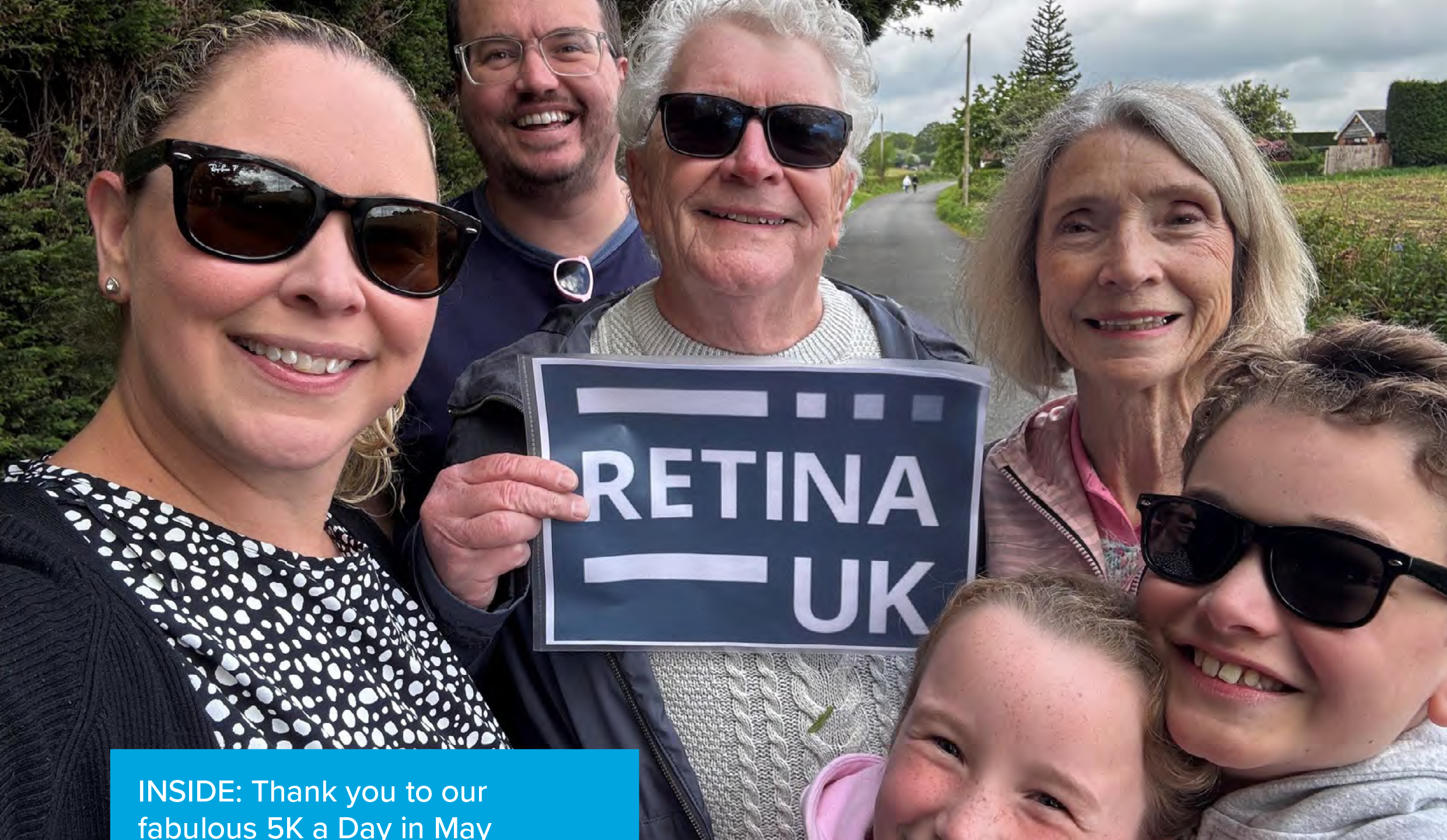
- Wow Wow Wow – 5K a Day in May! Thank you to everyone who took part in our annual event. Between you all you raised over £8,000! How lucky have we been with the weather this year! We have loved seeing your photos. Thank you so much to you all!
- Colin and Linda McArthur organised the Wight White Cane Walk on the Isle of Wight in late May alongside their friends and family and raised more than £5,000 (page 20-21). Their annual event goes from strength to strength. Thank you to you both for your valuable commitment in running this event so successfully!
If you would like to get involved, we’d love to hear from you. Call Maria on 07736 968158 or email [email protected]. Details of all of our upcoming challenge events can be found on our website: RetinaUK.org.uk/challenge.
Thank you to everyone who has fundraised for Retina UK over the last few months. Please share your photos with us at [email protected] or tag us on social media.
Fundraising challenges come in all shapes and sizes. Whether you’re taking on a world-famous marathon or a long-distance walk through the countryside, every challenge helps Retina UK continue funding research and supporting people affected by inherited retinal conditions.
This year, supporters Alex and Mark demonstrated that there is no single way to make a difference. One chose to run 26.2 miles through the streets of London, while the other walked more than 90 miles across Norfolk and Suffolk. Both experiences were life-changing in different ways.
Running towards acceptance
When Alex Smitherman signed up for the 2026 London Marathon, he wasn’t an experienced runner. In fact, he describes himself as a complete novice. His motivation came from a deeply personal connection: his partner, George, lives with retinitis pigmentosa (RP), a condition that also affects several members of his family.
After discovering Retina UK while researching RP and clinical trials, Alex decided to take on the marathon to raise funds and awareness. Over five months of training, he transformed from a non-runner into a marathon finisher, crossing the line in an impressive four and a half hours.
Fundraising was every bit as challenging as the training. Alex raised more than £2,500 through sponsorship, an online escape room game he created and a raffle supported by friends, family and his local community.
But the biggest impact wasn’t financial.
For years, conversations about RP had been difficult for the family. “The marathon forced us into talking about it and facing it,” he says. “Now we can have conversations about RP without crying or feeling awkward.” What began as a fundraising challenge became a way of helping loved ones come to terms with a diagnosis and feel less alone. Alex says the experience changed him personally too, showing him he was capable of much more than he had imagined.
Walking the Angles Way
For Diss Rotary Club President Mark Chamley, walking the Angles Way was an opportunity to combine fundraising with his love of the natural world.
Mark lives with retinitis pigmentosa (RP) and has no useful sight. In June, he and his wife Bernadette completed the route from Great Yarmouth to Knettishall Heath, covering 91.3 miles over six days. Bernadette guided Mark for the entire journey.
Their route took them through some of the most beautiful landscapes in East Anglia, including riverside paths, woodland trails, green lanes and open countryside. While Bernadette enjoyed sightings of deer, marsh harriers, egrets and dragonflies, Mark experienced the landscape in a different way.
Along the route he listened to birdsong from species including cuckoos, curlews, reed warblers and skylarks, while also experiencing nature through touch and sound.
“The whole walk just confirmed my opinion that we are very fortunate to live in such a beautiful region,” says Mark.
Friends joined sections of the walk, helping the miles pass more quickly, and the couple enjoyed visits to local cafés, bakeries, pubs and villages along the route.
Their journey ended at Thelnetham Windmill, where around 20 supporters gathered to welcome them across the finish line.
The challenge raised an incredible £4,500, to be shared equally between Retina UK, Vision Norfolk and Global Sight Solutions.
“I am very glad we did the Angles Way walk as it was a memorable experience,” says Mark. “But this is secondary to the amazing amount raised by the extremely generous support we have had.”
Ready for your own challenge?
Every mile completed and every pound raised helps Retina UK continue providing information and support to families affected by inherited sight loss, while funding the research that brings us closer to new treatments.
If Alex and Mark’s stories have inspired you, visit RetinaUK.org.uk/challenge to discover upcoming events and find a challenge that’s right for you. We’d love to welcome you to #TeamRetinaUK.
First healthy volunteer dosed with OCT-980
Octant has begun the first-in-human clinical testing of OCT-980, an investigational oral therapy designed to slow or halt the progression of rhodopsin-associated autosomal dominant retinitis pigmentosa (RHO-adRP) caused by certain RHO gene mutations that lead to protein misfolding.
Protein misfolding is when proteins fail to fold into their correct functional three-dimensional shapes. Instead of performing their normal jobs, these abnormally shaped proteins become insoluble and sticky. They clump together into toxic aggregates, which can disrupt cellular functions and cause various degenerative diseases.
RHO-adRP is the most common form of autosomal dominant RP. It is one of the most severe forms of the condition, with more than 150 known RHO mutations.
OCT-980 is a small molecule corrector therapy that aims to restore normal cellular function by addressing protein misfolding. While it has the potential to benefit a broad range of mutations in the RHO gene, it is not expected to be effective for every RHO variant due to differences in how mutations disrupt retinal function.
The Phase 1a portion of this trial is currently underway in Australia. The Phase 1b portion of the trial will then take place in the US.
Ocugen announce Phase 3 enrolment completion for OCU400
Ocugen has completed enrolment for the Phase 3 liMeliGhT clinical trial of OCU400, an investigational gene-agnostic therapy for retinitis pigmentosa (RP). Unlike traditional gene therapies that target a single mutation, OCU400 is designed to benefit people with many different forms of RP, regardless of the underlying genetic cause, making it the first gene-agnostic genetic therapy to reach Phase 3 testing.
OCU400 uses the NR2E3 gene to regulate key retinal functions, aiming to restore balance within retinal cells and improve retinal health.
The Phase 3 trial has enrolled 140 children and adults across 17 sites in the US and Canada. Participants include those with confirmed RHO mutations, other genetic causes of RP and some without a confirmed genetic diagnosis. Those receiving treatment will undergo sequential subretinal injections in both eyes if certain criteria is met.
The primary goal is to determine whether OCU400 improves navigation in low-light conditions. Top-line results are expected in early 2027, potentially supporting regulatory approval later that year. However, UK-based regulatory approval and NHS funding decisions mean widespread availability could still take several years.
Ocugen completes dosing of GARDian3 trial for OCU410ST
Ocugen has completed enrolment and dosing ahead of schedule in its pivotal Phase 2/3 GARDian3 clinical trial of OCU410ST, involving 63 participants across 14 US sites. The study is evaluating the safety and efficacy of a single subretinal injection for Stargardt disease caused by ABCA4 gene mutations. OCU410ST has the potential to work for a range of ABCA4 mutations and builds on encouraging Phase 1 results. The primary goal is to reduce atrophic lesion size after 12 months. Data from the 12-month follow-up is also expected to support a future Biologics License Application, marking an important step towards potential regulatory approval.
New nanoparticle gene therapy research provides hope for treating inherited sight loss
Researchers at Ghent University have published promising preclinical research that could expand treatment possibilities for inherited retinal diseases (IRDs). Current gene therapies typically use viral vectors to deliver entire replacement genes to alter genetic material, but these have limited capacity and cannot carry many of the large genes responsible for inherited sight loss.
This study investigated the use of lipid nanoparticles (LNPs) as an alternative delivery system. LNPs are tiny fat-like particles that can transport much larger genes into cells while protecting their genetic cargo and enabling its release.
Researchers successfully loaded the large EYS gene, which is associated with RP, into LNPs and demonstrated that the full-length gene could be delivered into retinal cells. The treated cells were able to produce the correct RNA needed for normal protein production. These findings were demonstrated in cultured retinal cells and retinal tissue from cows.
Although this research remains at a preclinical stage and has not yet been tested in humans, it represents an important advance. By overcoming the size limitations of viral vectors, lipid nanoparticles could make gene therapy a realistic option for many IRDs previously considered too difficult to treat.
Keep up to date with further developments via our e-News, Look Forward newsletter, social media, website, webinars and podcasts. Sign up at RetinaUK.org.uk/mailing-list.
Anna and Ellie live with different inherited retinal conditions, but their journeys share a powerful thread: a passion for technology, a commitment to accessibility, and a desire to support others living with sight loss. Through volunteering with Retina UK, both have found confidence, community and the opportunity to make a meaningful impact.
Independence through technology
Anna lives with Usher syndrome type 1D, a rare condition that causes profound deafness from birth and progressive sight loss. After receiving bilateral cochlear implants as a toddler, she now manages significant peripheral vision loss and night blindness, using a long cane to travel independently. As a BSc (Hons) Applied Computing student at Milton Keynes College, technology and accessibility have become central to her life.
“Living with Usher syndrome has shaped many aspects of my life,” she explains. “Technology has helped me maintain my independence, while learning about accessibility has shown me how important the right tools can be for people with dual sensory loss.”
Ellie, who lives with Stargardt disease, has a similar relationship with technology. Her condition affects central vision, and as she studies for a Level 3 IT qualification, accessibility has become a key part of her education and future ambitions.
“Technology has helped me maintain my independence,” she says. “Learning more about accessibility has given me confidence in what I can achieve.”
Finding community and support
Although Anna had known of Retina UK for years, it wasn’t until early 2025 – when her mum shared a link to the Young Adults peer support group – that she became actively involved.
“The group introduced me to other young adults living with inherited sight loss,” she says. “It was reassuring to connect with people who understood my experiences and were willing to share advice and support.”
“The Young Adults Network has been brilliant,” Ellie says. “From casual conversations that lift your mood to discussions about education, employment and living with sight loss, there’s always someone willing to listen and help.”
Ellie found their experiences invaluable. “They made me feel welcome from the start. Even when people haven’t faced the exact same challenges, they understand what it’s like to live with sight loss and are always willing to share advice and encouragement.”
Giving back through volunteering
Inspired by the support they received, both Anna and Ellie chose to volunteer with Retina UK.
Anna began by supporting technology related activities and helping others navigate accessible tech. Today, she is one of the administrators of ‘Tech Tribe’, the charity’s WhatsApp community for technology discussions. Alongside Ellie, she is also gradually taking over facilitation of the bi-monthly ‘Talking’ Tech peer support group meetings.
“The knowledge within the group is incredible,” Anna says. “People are always willing to help each other, whether it’s accessibility advice, assistive technology or everyday tech challenges.”
Ellie agrees. “Being able to support a space where people can learn about technology is incredibly rewarding,” she says.
Confidence, skills and belonging
For both young women, volunteering has been transformative.
“Volunteering with Retina UK has helped me build confidence, develop new skills and improve my public speaking,” Anna explains. “It’s shown me that sharing my own experiences can make a real difference to others.”
Ellie echoes this sentiment.
“Volunteering has helped me become more confident and more open to assistive technology. Finding Retina UK has helped me build confidence, develop new skills and find a community where I truly belong.”
To find out more about volunteering with Retina UK, please visit RetinaUK.org.uk/volunteer. For more information on our technology support, please
email [email protected].
Retina UK funded PhD student, Gabriel Velichova is currently working on a project that aims to examine if prime editing is a viable therapeutic approach for Stargardt’s disease. She attended the Association for Research in Vision and Ophthalmology (ARVO) meeting in Denver, Colorado in May and describes her experience as follows:
“It was an extraordinary opportunity to highlight work that sits at the heart of what Retina UK strives for: driving forward high‑quality research that brings us closer to effective treatments for inherited sight loss.
“I feel deeply honoured to work on a project that holds such promise for individuals and families living with Stargardt disease and related conditions. I am especially grateful for the guidance of Professor Jacqueline van der Spuy and for the generous support from Retina UK, without which this work would not be possible.
“Over the past three years, I developed a human cell model which allowed me to rigorously test and refine each component of the prime editing system.
Encouragingly, I demonstrated that prime editing could correct the targeted mutation in the ABCA4 gene with remarkable efficiency and accuracy, with negligible unintended edits. Early experiments demonstrated that prime editing is achievable, though further optimisation of the delivery method will be essential to achieve optimal results.
“The ARVO committee recognised the significance of these findings and invited me to present my work as a talk during the Gene Editing and Gene Therapy session. I was genuinely surprised and excited by the interest in the topic. The session was very well attended by over 200 scientists. One researcher from Australia even asked for advice on improving her own PhD project on prime editing. Throughout the conference, people kept stopping me to talk about my work. It allowed me to network with many incredible scientists and create connections for future collaborations.
“With more than 11,000 attendees from 75 countries, ARVO offered a unique space to learn from others and exchange ideas. I focused specifically on groups working to improve prime editing efficiency and gene therapy delivery. Talking to multiple scientists about their experience helped me decide on the next step of my project and saved me a lot of time and resources. This is one of the most valuable aspects of scientific research – sharing knowledge and experience.
Many groups shared insights about the benefits and drawbacks of using lipid nanoparticles (LNPs), and virus‑like particles (VLPs) for gene editing delivery. These discussions helped us identify a significant gap in research – no studies have yet tested LNPs and VLP‑mediated genome editing technologies in human‑derived RPE or 3D retinal organoids. These discussions, combined with preliminary work from our laboratory have inspired us to pursue further support for our ongoing research to identify the most effective delivery system for prime editors in ABCA4 disease models, including retinal organoids and RPE cells – an essential step toward developing a safe, scalable, non‑integrating gene‑editing therapy.
Presenting at ARVO was the culmination of years of hard work. It was incredibly validating to see how my research stands alongside work from leading groups around the world, and how it contributes to the growing momentum in gene editing and gene therapy. More than anything, it inspired new ideas which could take this work forward and ensure that this is not just another PhD project culminating in a thesis. These findings have the potential to become a gene therapy for people with ABCA4‑related disease. We need to pursue these rare opportunities because behind every experiment there are individuals, families, and future generations who deserve hope, choice, and the possibility of a brighter future.
When Tilly Dowler talks about sight loss, she does so with honesty, humour and an infectious determination to make the most of every opportunity.
Tilly, who lives with Stargardt disease, was diagnosed at the age of 15 after a long and frustrating search for answers. What began with symptoms during her GCSE years led to numerous hospital appointments before specialists at Moorfields Eye Hospital identified the condition.
“At first, I didn’t really accept it,” Tilly explains. “When I looked up Stargardt disease online, the images didn’t match what I was experiencing, so I convinced myself they’d got it wrong.”
For years, she rarely spoke about her sight loss. Even close friends were unaware that her vision was deteriorating. It wasn’t until 2022, when she was registered blind and began needing more support, that she started to confront the reality of her condition.
Yet that turning point also became the catalyst for something positive.
“I thought, if I don’t do things now, I might regret it later,” she says.
That mindset led Tilly and business partner Victoria to open an independent fashion boutique in Castle Donington in 2023. What began as a shared dream soon became a thriving community hub and an unexpected platform for sight loss awareness.
The shop has brought recognition, awards and even invitations to Buckingham Palace and the House of Lords. More importantly, it has helped Tilly discover a confidence she never knew she had.
“Before, I never told anyone I had a visual impairment. Now I shout about it,” she laughs.
Through social media, public speaking and community events, Tilly is challenging assumptions about what blindness looks like. She still has useful peripheral sight, but her central vision is significantly affected.
Unfortunately, misconceptions remain common.
“I get told all the time, ‘You don’t look blind,’” she says. “People think it’s a compliment, but what does blind look
like?”
Tilly is passionate about raising awareness of the reality that sight loss exists on a spectrum.
She remembers how isolated she felt growing up without knowing anyone else living with sight loss.
“Finding people you can connect with is a massive part of feeling confident,” she says. “Sight loss can be really
lonely and isolating.”
Her group in Castle Donington* has become a welcoming space where people can share experiences, advice and friendship. Attendance varies from a handful of people to nearly twenty, but Tilly values both the larger discussions and the more intimate conversations.
After closing the physical shop, Tilly is embarking on her next chapter. She plans to continue offering personal styling services online while expanding her public speaking and awareness-raising work.
For her, fashion, confidence and accessibility are closely connected. Whether discussing colour analysis, accessible makeup packaging or finding adaptive ways to work, Tilly believes everyone deserves the chance to feel good about themselves.
Her social media presence reflects that philosophy. Bright outfits, colourful hats and positive messages have helped attract a growing audience.
“People stare at you anyway when you’ve got a cane,” she says. “So I think, why not wear the pink fedora?”
“If I hadn’t had sight loss, I don’t think I’d have done half the things I’ve done,” she reflects. “People should feel confident enough to do what makes them happy. Life’s short. You’ve got to take the opportunities when they
come.”
For Tilly, raising awareness is not about focusing on what has been lost. It is about helping others understand the realities of sight loss, breaking down misconceptions and showing people that being visually impaired does not mean giving up on ambition, adventure or joy.
*Tilly’s peer support group is not part of the Retina UK Peer Support Group network.
Make a note in your diary and join one of our upcoming events. Details of all of our events can be found on our website RetinaUK.org.uk/events.
SEPTEMBER 2026
- London and South East Local Peer Support Group (5 September)
- Great North Run 2026 (13 September)
- The Kiltwalk 2026, Edinburgh (13 September)
- Retina UK Professionals’ Conference, Birmingham (18 September)
- Retina UK Annual Conference, Birmingham (19 September)
- Sheffield 10K (27 September)
- Robin Hood Half Marathon (27 September)
OCTOBER 2026
- Halloween Skydive (1-31 October)
- Great Scottish Run 10K, Glasgow (4 October)
- Cardiff Half Marathon (4 October)
- Great Scottish Run Half Marathon (4 October)
- Retina UK Day 2026 (8 October)
- Royal Parks Half Marathon (11 October)
- Chester Marathon (11 October)
- QAC Sight Village South-East, London (27-28 October)
DECEMBER 2026
- Big Give Christmas Challenge (1-8 December)
MARCH 2027
- Retford Half Marathon (14 March)
- Hampton Court Half Marathon (14 March)
- Bath Half Marathon (14 March)
APRIL 2027
- Sheffield Half Marathon (4 April)
- London Landmarks Half Marathon (4 April)
- Brighton Marathon (4 April)
- Manchester Marathon (18 April)
- TCS London Marathon (25 April)
Dates are subject to change. Please check our website for up-to-date information:
- Peer support groups: RetinaUK.org.uk/groups
- Webinars: RetinaUK.org.uk/webinars
- Challenge events: RetinaUK.org.uk/challenge
The 5K Wight White Cane Walk 2026
To mark the 50th anniversary of Retina UK, our Isle of Wight peer support group, alongside family, friends and supporters, organised a truly memorable and meaningful challenge – the 5K Wight White Cane Walk, brilliantly led and organised by Colin and Linda McArthur.
Participants carried a specially extended white cane, created by David Ewen, along Ryde seafront to Seaview and back, creating a powerful visual symbol of awareness for sight loss. The event highlighted the strength, unity and determination across our community.
It was a fantastic day filled with encouragement, connection and shared purpose. Those involved raised an incredible £5,143 – a testament to the generosity and enthusiasm of everyone involved.
A huge thank you and congratulations to everyone who took part, supported, donated, or helped organise the event, and especially to Colin and Linda for their leadership and organisation. Your energy and commitment have made this a truly special way to celebrate 50 years of Retina UK.
Luna Glasses are an innovative solution for people with night blindness and related conditions. Using advanced near-eye display technology, Luna enhances vision in low-light settings – helping you move more safely and confidently after dark.
Prescription lenses
Luna is fully compatible with prescription lenses. These can be fitted by any optician.
Customisable fit
Like a regular pair of glasses, Luna can be customised for a comfortable fit, they are both stylish and lightweight.
Adjustable brightness
Luna provides full control over brightness to suit a wide range of lighting conditions.
To find out more about Luna glasses please get in touch with our UK partner:
0800 085 6055
2nd generation. AI-powered smart glasses designed to support people with sight loss.
See More. Hear More. Do More.
Powered by Meta AI with an ultra-wide camera and open-ear audio.
Your everyday companion for more independence, confidence and freedom.
Two sizes:
- Standard fit
- Large fit
Three lens options:
- Clear
- Tinted
- Transitions*
Features
Describe your surroundings: Use Meta AI to identify objects, signs, landmarks and everyday items.
Read text aloud: Read menus, labels, signs and printed information on the go.
Navigate with confidence: Works alongside accessibility apps to help you find your way.
Open-ear audio: Hear guidance while remaining aware of traffic and the world around you.
Stay connected: Hands-free calls, messages, music and voice control.
Get help when you need it: Connect with Be My Eyes for hands-free visual assistance
Connects to your technology:
- Smartphones
- WeWalk smart cane
- Tablets and computers
Why buy from Sight and Sound Technology?
- Help getting started
- Friendly expert support
- Ongoing technical support
- Dedicated aftercare and troubleshooting
Your Ray-Ban | Meta smart glasses come with a full 2-year manufacturer’s warranty for complete peace of mind
Perfect alongside white canes, guide dogs, smartphone apps and everyday activities
0800 085 6055
Phone donations
If you would like to make a donation via telephone, please call our team on 01280 815900.
Your generosity will enable us to accelerate the search for treatments, whilst also providing vital support services.
Text donations
A simple and quick way to give!
- Text LFFIVE to 70560 to donate £5
- Text LFTEN to 70560 to donate £10
- Text LFTWENTY to 70560 to donate £20
Text donations will be added to your monthly phone bill and will cost your donation plus one standard network rate message.
Cheques
If you would like to donate by cheque, please send it to us at Freepost Retina UK.
Annual Conference
Book now to attend our Conference in Birmingham (or online) on Saturday, 19 September. The event is free to attend. Find out more at RetinaUK.org.uk/annual-conference.
- £10 could pay for the primers required for the DNA analysis that detects disease causing mutations that result in RP.
- £50 could pay for one hour of super resolution microscope imaging, allowing scientists to visualise how light sensing photoreceptors are damaged in RP.
- £100 could pay for one PhD student for a day.
We love being able to update you with what we’re up to and we will continue to contact you in the same way we always have. To change your preferences please call 01280 821334.
Retina UK is a Charitable Incorporated Organisation (CIO), registered in England and Wales. Registered charity number 1153851.