
Look Forward – Winter 2026 – Issue 192
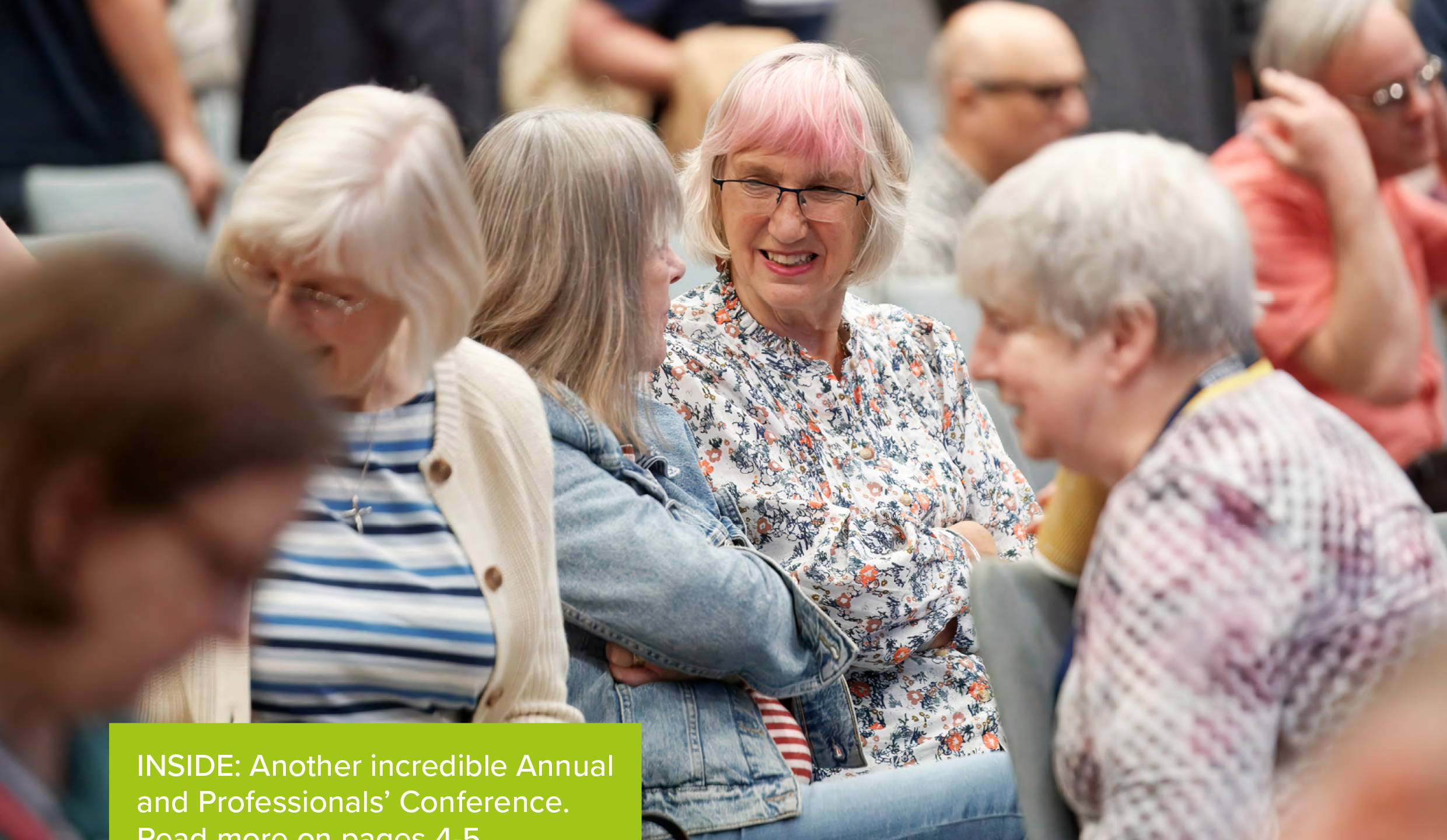
INSIDE: Another incredible Annual and Professionals’ Conference.
The nights are drawing in and the weather is colder (and wetter). It’s the perfect time to settle down with a cuppa and read our newsletter from cover to cover! We’ve included articles about the latest research, our Men’s Peer Support Group and a great feature about Cameron, who plans to race around the world on a Clipper. If you have any suggestions for content in future issues, please email Look Forward editor, Jane Russell, on [email protected].
Download Look Forward, Winter 2026:
- Accessible PDF PDF file | 4 MB
- Word plain text Word document | 56 KB
Newsletter content
Taking stock and looking forward
The team are busy taking stock, while I’m still reflecting on our September conferences and all that was achieved. Bringing together so many people affected by inherited retinal conditions to learn, share experiences and look ahead to the future was truly inspiring. Thank you to our speakers, our sighted guide volunteers and, most of all, our delegates for making it such a memorable event.
One of the highlights for me was hearing Professor Robin Ali talk about the latest developments in stem cell-derived therapies. The progress being made in this field offers real hope for the future. You can read more about this exciting project later in this newsletter.
Huge thanks to Professor Tara Moore OBE as she steps down from the Chair of our Scientific and Medical Advisory Board (SMAB). We are enormously grateful for all of her support and hard work.
You’ll find a postcard insert for the Big Give Christmas Challenge in this edition. If you’re able to support the campaign, your involvement could help us raise even more funds to support people living with inherited retinal conditions.
I was sad to learn that Sid Pritchard passed away earlier this year. I had the pleasure of meeting Sid when I first started with Retina UK, when we were still RP Fighting Blindness. Sid was one of a small group of volunteers whose insight and guidance helped shape my understanding of our community and the role the organisation plays in supporting it. I will always be grateful for Sid’s kindness, intelligence, steadfast commitment and, above all, his wonderful sense of humour. My sincere condolences to his family and friends.
This festive season, you can support Retina UK while buying gifts, festive essentials and Christmas cards.
Send a card that makes a difference
Our charity Christmas cards feature designs created by people living with inherited retinal conditions. Packs of five cost just £3 (plus P&P) and are available from: RetinaUK.org.uk/shop.
Raise free donations online
Many retailers will donate to Retina UK when you shop online, at no extra cost to you.
- Give as you Live
Shop through: giveasyoulive.com/charity/retinauk - Easyfundraising
Choose Retina UK as your charity and raise free donations whenever you shop: easyfundraising.org.uk/causes/retinauk
Every donation helps fund research, support services and information for people affected by inherited sight loss.
Thank you for supporting Retina UK this Christmas. For more information, email [email protected].
We’re delighted to share that our membership subscription has been refreshed, with new benefits and opportunities to stay connected.
Membership is about more than benefits. It’s about being part of a community committed to improving the lives of people affected by inherited sight loss.
Your support helps fund research, as well as provide trusted information and support services. It connects people through events and peer support and ensures the voices of those affected by inherited retinal conditions are heard.
To help keep membership sustainable, the annual subscription fee is now £30. This is the first increase in more than eight years.
If you’re already a member, thank you for your continued support. If you’ve been considering joining, there’s
never been a better time! Visit RetinaUK.org.uk/membership to find out more or call us on 01280 821334.
This year, nearly 1,000 people affected by inherited retinal conditions came together at our Annual and Professionals’ Conferences to learn, share experiences and look towards a future filled with growing possibility and hope.
Although the two events served different audiences, delegates shared many of the same reflections. People left feeling better informed, more connected and, perhaps most importantly, more hopeful.
For many attendees, hearing the latest updates from researchers and clinicians was a major highlight. From developments in gene therapies and stem cell research to discussions around clinical trials and future treatments, delegates valued the opportunity to hear directly from experts at the forefront of the field.
“The advances being made are incredible. It gives me hope that things are moving forward.”
Technology was another topic that generated significant interest. Sessions exploring assistive technology, artificial intelligence and accessibility tools attracted strong engagement from both people living with inherited retinal conditions and the professionals supporting them. Delegates particularly appreciated practical demonstrations showing how technology can enhance independence and open up new opportunities in everyday life.
Alongside the presentations, attendees repeatedly highlighted the power of hearing from people with lived experience. Through personal stories, panel discussions and informal conversations, delegates gained insight into the realities of navigating life with sight loss. These experiences brought scientific and clinical information to life while reminding everyone that behind every diagnosis is a unique individual and family.
For many Annual Conference delegates, the opportunity to connect with others facing similar challenges was just as valuable as the formal programme. Living with a rare inherited retinal condition can feel isolating, and many attendees spoke about the sense of understanding and belonging they experienced.
“I always come away feeling less alone. There’s something incredibly reassuring about being in a room full of people who just ‘get it’.”
The same spirit of connection was evident at the Professionals Conference, where delegates shared ideas, best practice and learning across genetics, rehabilitation, education, research and support services.
Accessibility remained at the heart of both events, with a range of adjustments helping to ensure everyone could participate fully. Delegates also reported plans to explore new technologies, access support services, get involved in research, strengthen professional practice, volunteer, fundraise and connect with peer support networks.
In short, our Conferences did far more than provide information. They inspired action, strengthened connections and demonstrated the power of bringing our community together.
Recordings from both Conferences are available at RetinaUK.org.uk/resources, as well as on YouTube and Spotify. If you would prefer to receive the audio on CD or USB, please call 01280 821334 and we will be happy to send a copy.
When Annabelle (Annie) King takes on the TCS London Marathon in April 2027, she’ll be running for a cause that means a great deal to her and her family.
She has seen first-hand the difference Retina UK can make through the support they have provided to her cousin, Jay, who was diagnosed with retinitis pigmentosa (RP) in 2009. Watching him face the challenges of declining eyesight, and seeing his confidence grow with their support, inspired her to give something back.
“It’s been tremendous for our family to see how much Retina UK has been able to help him and build his confidence,” says Annie.
Annie has been particularly pleased to see the difference the Young Adults Group has made, helping Jay connect with others who understand his experiences.
“Retina UK is very special to me and to our family because of that,” she says. “It will be lovely to be able to give back and help other people, knowing how much they’ve helped Jay.”
She’s already made a fantastic start. Just three weeks after setting up her fundraising page, Annie had raised
£2,020 towards her £3,000 target, thanks to the generosity of family and friends. Her grandparents, including her grandmother in Spain, have been
spreading the word, while other relatives are exploring fundraising ideas of their own.
Annie completed a half marathon in May 2026 and is now preparing for the bigger challenge ahead. She plans to build up gradually before starting a more structured marathon training plan around Christmas.
She’ll have plenty of support on the day, too. Her brother Henry and his girlfriend have also secured places in the Marathon and family and friends are looking forward to cheering them on in London.
For Annie, the challenge is about much more than crossing the finish line. It’s an opportunity to thank a charity that has made a real difference to someone she loves.
We’re incredibly grateful to Annie and everyone supporting her on this journey. Good luck, Annie – we’ll be cheering you on all the way to the finish line!
If you have been inspired to take on a challenge for #TeamRetinaUK, we’d love to hear from you. Please visit our website: RetinaUK.org.uk/challenge or call us on 01280 815900.
2nd generation. AI-powered smart glasses designed to support people with sight loss.
See More. Hear More. Do More.
Powered by Meta AI with an ultra-wide camera and open-ear audio.
Your everyday companion for more independence, confidence and freedom.
Two sizes:
- Standard fit
- Large fit
Three lens options:
- Clear
- Tinted
- Transitions*
Features
Describe your surroundings: Use Meta AI to identify objects, signs, landmarks and everyday items.
Read text aloud: Read menus, labels, signs and printed information on the go.
Navigate with confidence: Works alongside accessibility apps to help you find your way.
Open-ear audio: Hear guidance while remaining aware of traffic and the world around you.
Stay connected: Hands-free calls, messages, music and voice control.
Get help when you need it: Connect with Be My Eyes for hands-free visual assistance
Connects to your technology:
- Smartphones
- WeWalk smart cane
- Tablets and computers
Why buy from Sight and Sound Technology?
- Help getting started
- Friendly expert support
- Ongoing technical support
- Dedicated aftercare and troubleshooting
Your Ray-Ban | Meta smart glasses come with a full 2-year manufacturer’s warranty for complete peace of mind
Perfect alongside white canes, guide dogs, smartphone apps and everyday activities
0800 085 6055
- James Moore ran the Limerick half marathon after taking part in his first outdoor run only two months before! He raised over £1,000! We are so grateful James and can’t wait to see what you do next!
- James and Katie Lee took on the 21-mile Mighty Stride at the Edinburgh Kiltwalk in support of their son who was diagnosed with X-linked retinoschisis at just two years old. They raised a wonderful £508. Thank you both so much!
- Jane Sellars arranged a Sunday Brunch at St Francis Church. They raised £155. We are so grateful and what a lovely way to spend a Sunday!
- Friends Ricki McInnes and Gordon Donaldson took on the Edinburgh Kiltwalk and raised an incredible £2,250 for Retina UK! Thank you both so much for your amazing support!
- Colette Bardell arranged a wonderful event full of mindfulness yoga and healthy food and raised £140. Thank you so much Colette.
- Janette Burton took on a 50km ultra challenge for us and raised an incredible £500!
- Christopher Doggett and his guide runner Kian Mokhtary took on the Great North Run, raising an amazing £715 for Retina UK. The pair crossed the finish line in an incredible one hour and 42 minutes! A huge thank you.
- Joe Bourke, Kim Lamb and Amanda Anderson took to the skies for Retina UK, raising a fantastic £2,202 through their tandem skydives! Thank you all for being so courageous.
- Lisa Sandford and her parents recently held a cake and handmade craft sale. They raised a wonderful £275! Thank you to the Sandford family for all their continued support.
- Fatima Arman took on her first proper trek in the Malvern Hills, tackling 15 peaks across nine miles and raising a fantastic £320 in just one week! A huge thank you to Fatima for her wonderful support!
- Rayan Osborne recently took to the skies with a skydive in Kent and raised an incredible £2,000! A big thank you from us all.
- In September Tanya Rickard and her lovely family arranged a charity ball in Devon. She raised over £10,000. We cannot thank her enough for supporting us.
- On Friday 9 October, Max Mountstevens organised a school cake sale in support of Retina UK. The event was a huge success, raising over £400. Well done, Max! Your enthusiasm, kindness and commitment to supporting those affected by sight loss are making a real difference.
If you would like to get involved, we’d love to hear from you. Call Maria on 07736 968158 or email [email protected]. Details of all of our upcoming challenge events can be found on our website: RetinaUK.org.uk/challenge.
Thank you to everyone who has fundraised for Retina UK over the last few months. Please share your photos with us at [email protected] or tag us on social media.
Atsena presents positive early data from XLRS trial
Atsena Therapeutics has reported encouraging early results from its clinical trial of ATSN-201, an investigational gene therapy for X-linked retinoschisis (XLRS), a rare inherited retinal condition caused by mutations in the RS1 gene. It currently has no cure, mainly affects males and can cause significant loss of central vision because the layers of the retina split apart (foveal schisis).
ATSN-201 aims to address the underlying genetic cause by delivering a functional RS1 gene directly to the retina through a subretinal injection.
It is being studied in the multi-phase LIGHTHOUSE clinical trial in the US, with early results from part A showing a favourable safety profile, sustained foveal schisis closure in most treated eyes and statistically significant improvements in retinal structure and visual function. Participant recruitment is underway for the study’s pivotal phase 3 portion, with enrolment expected to complete by end of Q1 2027.
RTx-015: Optogenetic therapy for RP and Choroideremia
Ray Therapeutics is investigating RTx-015, an experimental optogenetic gene therapy for people with advanced retinitis pigmentosa (RP) and choroideremia.
Unlike conventional gene therapies, which aim to correct a specific genetic fault, optogenetic therapy is designed to work regardless of the underlying genetic mutation. RTx-015 uses gene therapy techniques to provide retinal ganglion cells with the instructions to build a light-sensitive protein. These cells normally transmit signals from the retina to the brain but do not detect light. The aim is for them to take over some of the function lost when photoreceptors, the retina’s normal light-sensing cells, degenerate.
The treatment cannot replace healthy photoreceptors or restore normal vision, but researchers hope it could provide useful visual function, such as light perception, in people with advanced disease.
RTx-015 is currently being tested in a Phase 1 clinical trial in the US. Participants receive a single intravitreal injection into one eye and are monitored for five years. The early-stage study is primarily assessing safety and determining appropriate doses.
Although RTx-015 has received regulatory designations intended to support faster development, it remains experimental. Further clinical trials will be needed to establish its safety and effectiveness.
Photoswitch drugs show promise in preclinical studies
Researchers at the Institute for Bioengineering of Catalonia (IBEC) have developed experimental photoswitch drugs that restored useful visual function in blind mice and zebrafish in preclinical studies. This approach could potentially help those with advanced inherited retinal diseases, where light-sensitive photoreceptor cells have been lost.
Photoswitchable drugs are small molecules that change their behaviour when exposed to light. In darkness they remain inactive and when illuminated, they change shape and activate nerve cells in the retina. Instead of repairing damaged photoreceptors, these drugs could allow other retinal cells to detect light, bypassing the degenerated photoreceptors.
Two compounds, prosthe6-12 and prosthe6-15, produced particularly promising results. Treated animals were able to detect light, respond to visual stimuli and use visual information to navigate.
Unlike gene therapy, the treatment does not alter DNA, and unlike retinal implants, it does not require surgery. Its effects are also potentially reversible and repeatable. However, the treatment would not restore normal vision and is still at the preclinical stage. It has not yet been tested in humans.
Researchers are now studying safety, how long the effects last and exploring development towards future clinical trials.
Breakthrough BBS10 treatment marks major milestone
An 11-year-old girl has become the first person in the UK to receive an experimental gene therapy for BBS10-associated retinal dystrophy, a form of Bardet-Biedl syndrome (BBS). The treatment, developed by MeiraGTx, has been provided under an MHRA
Specials Licence, limited to a very small number of patients identified by a specialist clinical team.
This is an exciting and significant milestone for our community, particularly those living with BBS, and an encouraging step forward in research towards potential treatments.
Our Lived Experience Panel is a great way to hear about opportunities to take part in focus groups, surveys, research projects and clinical trials. To join, visit RetinaUK.org.uk/lived-experience or call 01280 821334.
Keep up to date with further developments via our e-News, Look Forward newsletter, social media, website, webinars and podcasts. Sign up at RetinaUK.org.uk/mailing-list.
Living with inherited sight loss can sometimes feel isolating. Friends and family may do their best to understand, but some experiences are difficult to explain to people who haven’t lived through them.
That’s where Retina UK’s Men’s Peer Support Group makes a difference.
For the men who attend, it’s much more than a monthly meeting. It’s a place to share experiences, exchange advice, ask questions and connect with others who understand the realities of living with inherited sight loss because they’re living with it too.
The group brings together men from across the UK, all at different stages of their journey. Some have lived with an inherited retinal condition for decades, while others are still adjusting to a recent diagnosis. Despite their different experiences, members quickly discover they have much in common.
For John, one of the biggest benefits is being surrounded by people who simply understand.
“You can just say it and everybody gets it. You don’t have to explain yourself. Everybody’s been through it in some way.”
It’s a feeling many members recognise. Outside the group, they may find themselves repeatedly explaining why they struggle in certain lighting conditions or why everyday tasks take longer than they once did. Within the group, those explanations aren’t necessary.
That shared understanding often leads to practical support as well. Members exchange tips about technology, accessibility, mobility and adapting to everyday life. Someone who has already faced a particular challenge can offer reassurance and advice to someone experiencing it for the first time.
But while practical information is valuable, members say the emotional support can be even more important.
The group provides a space where men can talk openly about concerns, frustrations and changes in confidence without fear of judgement. There is no pressure to speak, but there is a shared understanding that everyone will be listened to with empathy and respect.
For Keith, this openness has been one of the group’s greatest strengths.
“All the things that I’ve wanted to know but were frightened to ask. Everybody always says no question is too silly.”
The confidence that comes from hearing others share similar experiences can be powerful. Members often realise they are not alone in the challenges they face or the way they feel.
What starts as a support group frequently develops into something deeper. Friendships form, people check in on one another between meetings, and conversations continue through the group’s WhatsApp community.
For Stevie, who joined after receiving his diagnosis, that sense of community is invaluable.
Importantly, meetings aren’t solely focused on the challenges of sight loss. Alongside serious conversations, there is plenty of humour, friendship and friendly banter.
“The support group gives you that comfort. Everyone gets it. They understand the situation and what you’re going through.”
At its heart, the Men’s Peer Support Group is about connection. It’s about knowing that when something difficult happens, there are people who understand. The advice is useful and the information is valuable, but for many members the greatest benefit is a sense of belonging and the reassurance that they don’t have to face inherited sight loss alone.
To find out more about Retina UK’s peer support groups, visit RetinaUK.org.uk/groups.
For many of the sighted guide volunteers who supported this year’s Retina UK Annual and Professionals’ Conferences, the experience offered far more than helping attendees navigate the venue. It provided an opportunity to learn, build meaningful connections and gain a deeper understanding of life with inherited sight loss.
What made this year’s volunteer team particularly special was the variety of routes that brought people to the role. Several volunteers, including medical students Joshan, Francesca and Seren heard about the opportunity through a university medical WhatsApp group and word of mouth. Others discovered Retina UK through local volunteering networks and job-seeking websites. Despite finding the role in different ways, all shared a desire to support others and learn more about the sight loss community.
Joshan, a second-year medical student, was inspired to volunteer after learning more about Retina UK’s work.
“Retina UK makes a real difference to those affected by sight loss, helping them go about their day-to-day life and giving them a platform to talk about their personal experiences. This inspired me to do my bit to help.”
Although many volunteers were new to sighted guiding, Retina UK provided training and support to ensure everyone felt prepared and confident.
For Francesca, another medical student volunteer, the experience was both enjoyable and eye-opening. She guided an attendee from the train station and supported her throughout the Conference.
“She was a joy to be around, and I got lots of life advice whilst also learning so much about her own personal experiences with sight loss.”
A common theme among volunteers was how much they learned through conversations with attendees. Seren, a third-year medical student, initially expected the role to focus on practical support. Instead, she found herself gaining valuable insight into the everyday realities of living with sight loss.
“I didn’t truly realise how much I would learn. It was hearing about his experience of living with sight loss and how his condition had changed over time that was really the most memorable part.”
Sighted guide volunteer John Rae discovered the opportunity through his local volunteering network and was keen to learn more about Retina UK’s work.
“I was surprised to find how large the Annual Conference was and the important role Retina UK plays in supporting people affected by inherited sight loss and driving medical research forward.”
For Libbi, who came across the role through a popular job-seeking website, the experience challenged assumptions she had carried for years.
“I had little experience of the deafblind community and often worried about saying or doing the wrong thing. I assumed supporting someone with sight and hearing loss would be difficult, but the reality was very different.”
Libbi quickly realised that confidence comes through conversation, understanding and simply treating people as individuals.
“Their patience, humour and openness made the day a pleasure. By the end of the Conference, I wasn’t thinking about disability at all. I was simply enjoying spending time with someone and learning from their experiences.”
Reflecting on the impact of the day, Libbi adds:
“Volunteering makes a real difference, not only to the people you’re supporting but also to yourself. The hardest part was overcoming my own uncertainty beforehand.”
Through meaningful conversations and shared experiences, our volunteers gained a deeper understanding of inherited sight loss and the strength, resilience and positivity of the Retina UK community.
Many have already expressed a desire to volunteer again; a reflection of the lasting impact the experience had on them. In many ways, the people they came to support inspired them in return.
To find out more about volunteering with Retina UK, please visit RetinaUK.org.uk/volunteer or email our Volunteer Manager, Anish Nathwani on [email protected].
As the UK’s leading provider of hardware and software to the blind, visually impaired and those with learning and reading difficulties, our products can improve your quality of life at work, at study or at home.
MiniVision2+
- Customisable Display with large fonts
- Voice commands and recognition
- Where Am I and Safety Assistance
- Enlarged, spaced & embossed keyboard
- Intuitive Keypad with Shortcuts
- Premium Voice Synthesis
- Crystal-clear Audio and Loudspeaker
- Camera, Gallery, and MMS
More Powerful, Fast Charging and packed with Features
- Simplified Use: 2 user modes via keypad with spaced keys and voice commands.
- Features: Camera, Notes, Safety Assistance, Banknote Detector, Weather, Calculator, Alarm, FM Radio, Voice Recorder, Flashlight, Calendar, Location Finder, Banknote Detector,
- Adapted Ergonomics and User Interface: light, elegant feature phone with perfect grip and dropdown menu system with tailored accessibility parameters
MiniVision2+ £342.50.
If you prefer a smartphone with big buttons, voice commands and connectivity to apps such as WhatsApp, Audible, Internet Shopping or Banking, check out the SmartVision 3.
We have a range of solutions to meet your needs, visit our website to find out more.
0800 085 6055
In December, Retina UK will once again take part in the Big Give Christmas Challenge, bringing our community together with an ambitious goal to raise £75,000 to support vital research into treatments for inherited sight loss.
The Big Give gives us an incredible opportunity to make donations go further. From midday between 1–8 December, donations will be doubled through match funding, meaning your gift could have twice the impact. Research needs continued investment to turn promising discoveries into treatments that could make a real difference to people’s lives.
Your support during the Big Give can help us take the next steps. Please ‘like’ and ‘share’ our social media content and visit RetinaUK.org.uk/big-give for more information and to make your donation (this link will redirect to The Big Give website when the campaign starts).
Whether you donate £10, £50 or more, every gift will contribute towards our shared ambition. If you have supported a previous Big Give campaign, you’ll know just how powerful it can be when our community comes together. If you are considering making a donation to Retina UK, the Big Give is a perfect opportunity to double your impact.
“Supporting Retina UK through the Big Give is something I look forward to every year. Knowing that my donation is doubled means I can make an even bigger difference. It’s reassuring to know that my gift is helping people affected by inherited sight loss access support, information and hope for the future.”
Retina UK supporter, Jane
If you have any questions or would like further information, please email [email protected] or call our friendly team on 01280 815900.
For many people living with progressive vision loss, there comes a point when reading becomes difficult, faces become hard to recognise, and independent daily life becomes challenging. Once the light-sensing cells responsible for central vision are lost, they don’t naturally grow back, and there are currently very few treatment options. As many experimental therapies require a minimum number of remaining light-sensing cells, people with late-stage vision loss often can’t take part in clinical trials.
These are the challenges that Professor Robin Ali and Professor Rachael Pearson at King’s College London are tackling. Their pioneering research could open an entirely new way of treating inherited retinal conditions. For over two decades, the team has been developing a treatment based on a simple but ambitious idea: replacing damaged light-sensing cells with healthy new ones. Their research has shown that when some people lose their light-sensing cells, much of their retina’s wiring stays intact. In theory, introducing healthy replacement cells could allow those connections to be rebuilt. Visual signals might reach the brain once again, and some level of sight could be restored.
Crucially, this approach could help people with advanced sight loss who can’t benefit from gene-specific treatments. Rather than targeting a particular genetic fault, the goal is simply to replace the cells that have been lost.
The team has already achieved promising results in the laboratory. Over the last twenty years, they’ve developed replacement cells that survive for at least a year when transplanted into mice. These light-sensing cell transplants can also restore visual responses in mice with advanced progressive sight loss. Based on these encouraging results, the researchers are now preparing for their first clinical trial, expected to begin in early 2028. This study will test the treatment in a small group of people with advanced inherited retinal disease.
“Our programme has now reached the point where we are manufacturing photoreceptor cells for our first clinical trial to test whether this approach can restore vision.”
Professor Robin Ali.
The trial represents a major milestone, but the researchers are already looking beyond it. If the treatment proves safe, subsequent clinical trials will be needed to test whether it restores a meaningful level of vision. One of the biggest challenges will be ensuring enough replacement cells can be produced for these trials.
That’s the focus of Retina UK’s latest investment in the team. The Green Light project is designed to make the process of producing replacement cells more affordable and faster. At present, preparing cells for transplant is complex, time-consuming, and expensive. While the team can produce enough cells for an early-stage trial, much larger numbers will be needed for future studies and, ultimately, for routine patient treatment.
“This project is part of a much bigger programme to develop a therapy to restore vision in patients with advanced retinal degeneration,” says Professor Ali.
There’s still a long road ahead, and no one can know yet how successful the first clinical trial will be. But the progress made so far represents decades of sustained research, much of it supported by Retina UK and our community of supporters.
For people living with advanced inherited sight loss, this research doesn’t offer a cure or perfect vision. But it could enhance someone’s ability to see the world around them, including seeing their loved ones’ faces again. And with every step forward, that possibility comes a little closer.
We will be launching our exciting Green Light Appeal in January 2027.
“The Retina UK-funded project will develop more cost-effective manufacturing methods so we can scale up this therapy to many more patients.”
Professor Rachael Pearson
At just 18 years old, Cameron Harris is preparing to take on one of the biggest challenges of his life: sailing in the renowned Clipper Round the World Race. It is an extraordinary ambition for anyone, but for Cameron, who was diagnosed with retinitis pigmentosa a year ago, the journey carries even greater significance.
Growing up on Scotland’s west coast near Oban, the sea has always been part of Cameron’s life. He first learned to sail at the age of 12 through a local sailing club partnership with his high school. What started as a pastime quickly became a passion, and over the years he became deeply involved in the sailing community, volunteering and serving on the club committee.
His diagnosis in October 2025, came following a routine eye examination. Cameron initially didn’t realise anything was wrong.
“I thought what I was seeing was normal,” he explains. “It wasn’t until after the diagnosis that I started recognising things I’d always adapted to without realising.”
One of the hardest consequences of is diagnosis came after he began learning to drive. Following visual field testing, the DVLA determined that he did not meet the required visual standards, and his driving licence was revoked just a week before his driving test.
“It was devastating,” he says.
Yet Cameron’s story is one of adaptation and determination rather than limitation. He is currently working towards a HNC apprenticeship in Mechanical Engineering at Glensanda Quarry. Following discussions with occupational health, he moved from a practical, machinery-based role into an office-based engineering systems position, managing work orders, purchase orders and other operational processes. Cameron is full of praise for his employer, who have worked hard to support him and ensure he can continue building his career.
After touring a Clipper yacht when it visited Oban in July, Cameron decided to apply. The process moved remarkably quickly. Within days he had completed the interview stages and received confirmation that he had secured a place on the race. What struck him most was the sense of community.
“You’re never alone, everyone works together and looks out for each other.”
Training begins in early 2027, with four weeks of intensive preparation before the race starts later in the summer. If all goes to plan, Cameron will spend around 11 months circumnavigating the globe, crossing oceans, visiting ports around the world and living alongside the same crew throughout the adventure.
The race comes with a significant financial commitment. Cameron and his family are working tirelessly to raise the funds needed.
The name of Cameron’s campaign, Before the Dark: A Race Against Time, reflects the motivation behind the challenge.
“There’s no timeline for my remaining vision,” he says. “I want to make as many memories and see as many places as possible.”
But the campaign is about more than one sailing adventure. Cameron already has plans for the future. After completing the race, he hopes to launch a new initiative called Beyond the Waves, using his experiences to inspire others, particularly young people facing adversity or disability, to pursue their ambitions.
His message is simple but powerful: “Don’t let anything stop you. Yes, I’ve been diagnosed with this condition, but why should it stop you from chasing your dreams or creating new ones?”
Cameron’s philosophy is that sight loss does not have to define his future. With courage, determination and a strong support network behind him, he is setting sail towards an extraordinary goal.
To follow Cameron’s journey visit before-the-dark.co.uk/.
Make a note in your diary and join one of our upcoming events. Details of all of our events can be found on our website RetinaUK.org.uk/events.
MARCH 2027
- Bath Half Marathon (14 March)
- Sight Village Greater Manchester (16 March) – tbc
- Retford Half Marathon (21 March)
APRIL 2027
- Sheffield Half Marathon (4 April)
- Wizz Air Milan Marathon (4 April)
- Brighton Marathon (4 April)
- TCS London Marathon (25 April)
MAY 2027
- Tough Mudder (various dates and locations)
- Sight Village Nottingham (4 May) – tbc
- Hackney Half Marathon 2027 (16 May)
- Edinburgh Marathon (30 May)
JULY 2027
- The 5K Wight White Cane Walk 2027 (4 July)
- Sight Village Birmingham (6 July) – tbc
SEPTEMBER 2027
· Great North Run (12 September)
Dates are subject to change. Please check our website for up-to-date information:
- Peer support groups: RetinaUK.org.uk/groups
- Webinars: RetinaUK.org.uk/webinars
- Challenge events: RetinaUK.org.uk/challenge
Webinar: Ask the expert with Dr Roly Megaw
Joining us for an “Ask the Expert” session is Dr Roly Megaw, Clinical Lecturer and Honorary Consultant Ophthalmologist at University of Edinburgh and NHS Lothian.
Dr Megaw has recently supervised a Retina UK / Macular Society PhD studentship and has received other Retina UK research funding in the past.
You can ask your questions in advance or bring them with you to ask using the Q&A box during the session.
Whether you have a burning question or want to learn more about the latest research developments, this is your chance to engage directly. Register today and be part of the conversation! RetinaUK.org.uk/webinars
Every donation to Retina UK helps us accelerate the search for treatments for inherited sight loss while providing vital information, support and services to our community. There are lots of ways to support us, and every contribution makes a difference
Make your gift:
- Online: Make a one-off or regular donation using a debit or credit card through our website: RetinaUK.org.uk/donate.
- By phone: Call our friendly team on 01280 815900 to make a donation by card.
- By text: Text LFFIVE to 70560 to donate £5. Text LFTEN to 70560 to donate £10. Text LFTWENTY to 70560 to donate £20.
- By bank transfer: Contact our team for our bank details if you would prefer to donate directly from your bank account. Call us on 01280 815900 or email [email protected].
- By cheque: Send your cheque, payable to Retina UK, to Retina UK, Whiteleaf Business Centre, 11 Little Balmer, Buckingham, MK18 1TF.
This December make your gift go further by making your donation through The Big Give Christmas Challenge which runs from midday on 1-8 December. Thank you for your support.
Look Forward is available as a hard copy, by email, audio (CD or memory stick) and in Braille. Get in touch if you’d like to receive a copy in one (or more) of these formats. If you no longer wish to receive Look Forward, please let us know by emailing [email protected].
Retina UK is a Charitable Incorporated Organisation (CIO), registered in England and Wales. Registered charity number 1153851.