Scientific & Medical Advisory Board
Our Scientific & Medical Advisory Board (SMAB) advises our Board of Trustees in order that they can approve grants for research projects.
Search results
Our Scientific & Medical Advisory Board (SMAB) advises our Board of Trustees in order that they can approve grants for research projects.
Many inherited sight loss conditions occur when cells in the retina, which is the light-sensitive region at the back of the eye, deteriorate in an unpredictable way. These conditions are often referred to as inherited retinal dystrophies.
The latest research news piece from Retina UK.
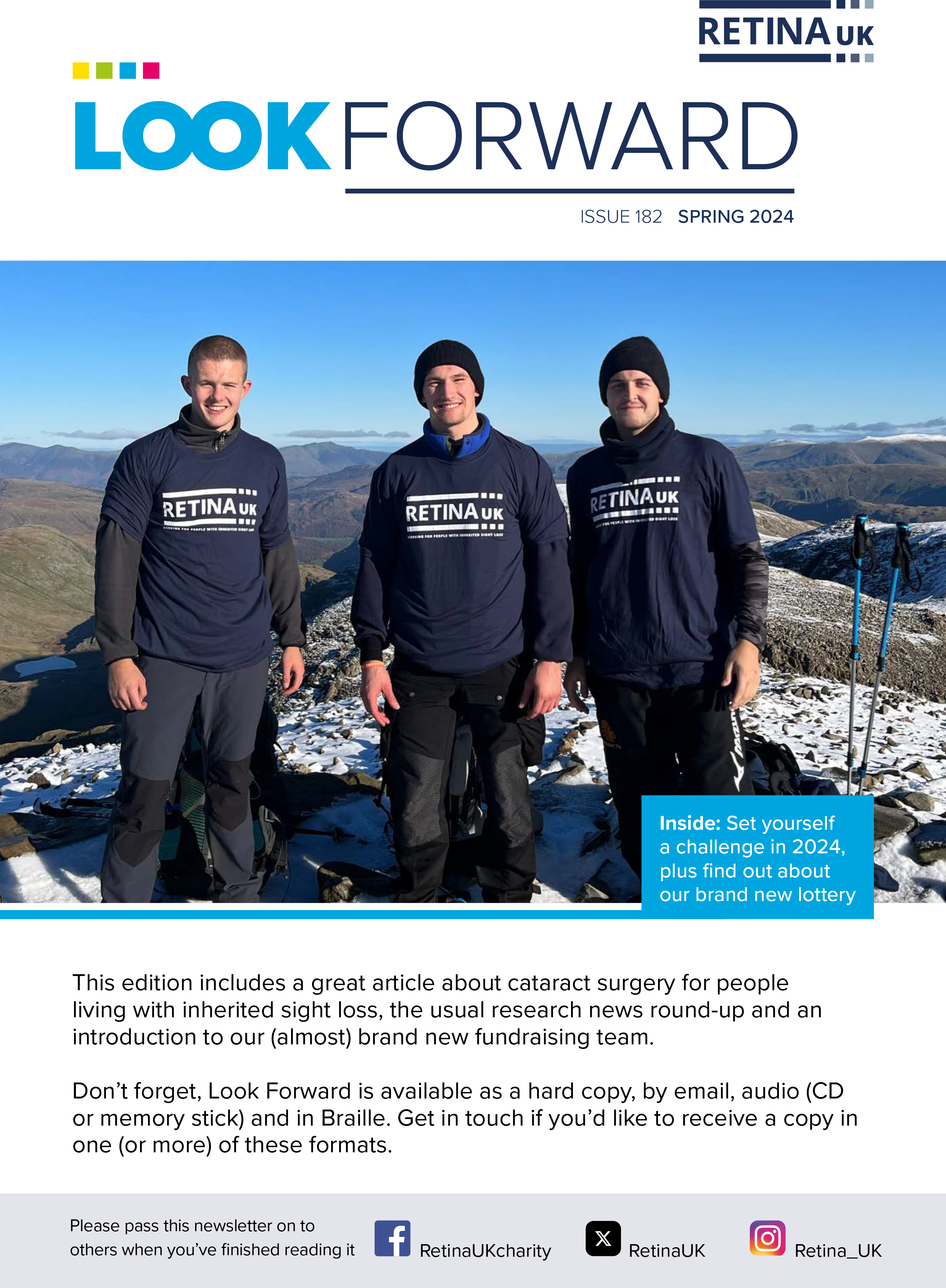
Inside this edition, set yourself a challenge in 2024, plus find out about our brand new lottery.
Our partnerships are mutually beneficial. For Retina UK this means we can fund more research and offer support on a local level, while our partners can achieve corporate social responsibility objectives whilst making a tangible impact.
Our Keynote speaker will be Mr Kanmin Xue. Mr Xue is a Consultant Vitreo-retinal Surgeon at the John Radcliffe Hospital and Wellcome Trust clinician scientist fellow at the University of Oxford where he leads the Retinal Disease and Repair Group.
Prof Mariya Moosajee at Moorfields Eye Hospital has asked us to share the message below about the clinical trial she is running. This trial is for a treatment that targets a particular section of the USH2A gene.
CRISPR gene editing leads to improvements in vision for people with inherited blindness, clinical trial shows.
Retina UK is delighted that the Scottish Medicines Consortium (SMC) has accepted the gene therapy Luxturna (voretigene neparvovec) for ongoing use by the NHS in Scotland.
This time we are joined by Roly Megaw, Clinical Lecturer and Honorary Consultant Ophthalmologist at University of Edinburgh and NHS Lothian