
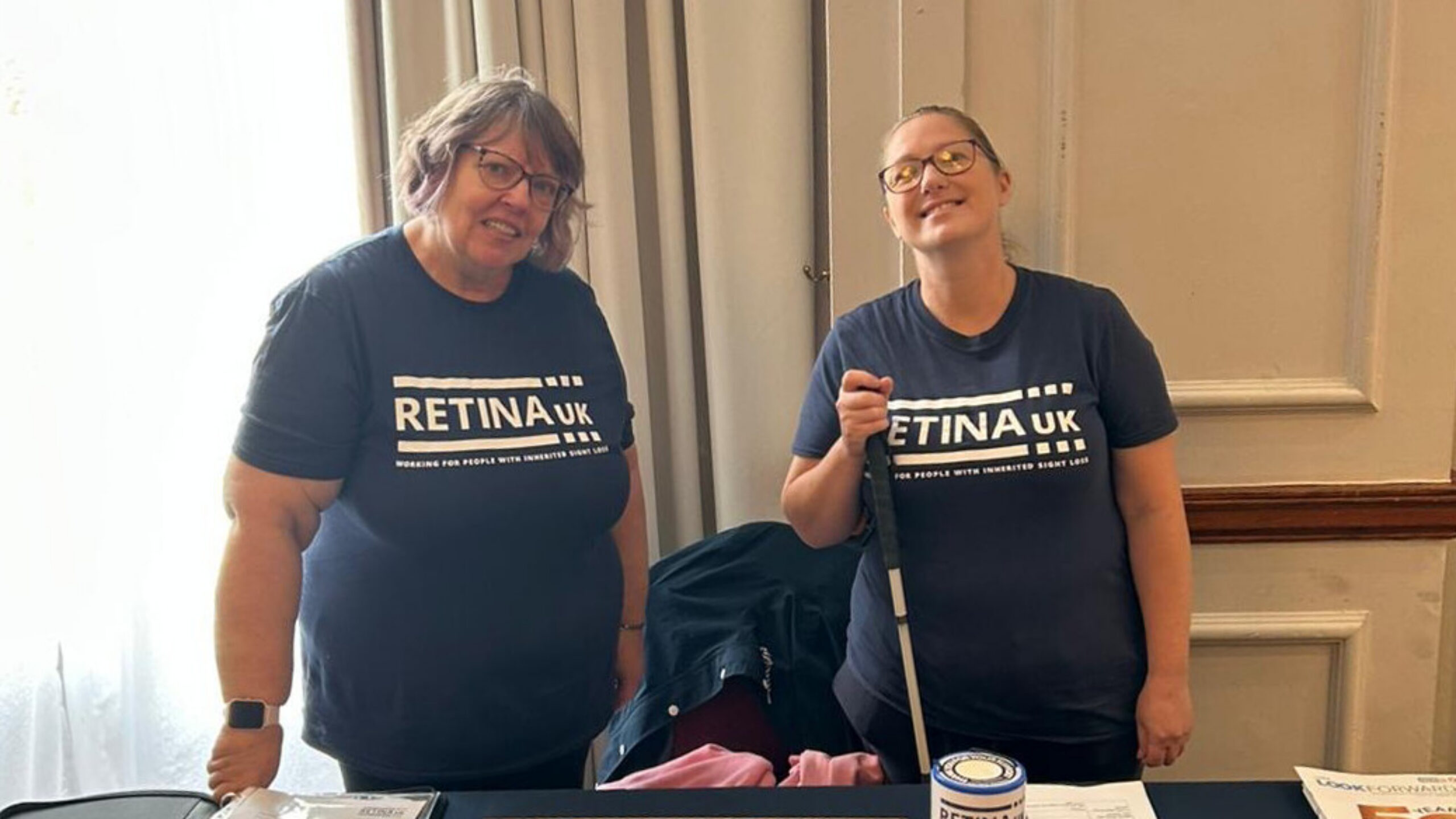
Meet our volunteers: Suzanne and Anne
For people living with inherited retinal conditions, finding others who understand can make a profound difference. In the South-West, volunteers Suzanne and Anne are helping to create those connections – offering support, understanding and a strong sense of community across a wide and largely rural area.
Although they live some distance apart, their shared experiences and commitment to volunteering have brought them together through Retina UK.
Two journeys, shared understanding
Suzanne was diagnosed with retinitis pigmentosa (RP) in 2017. Although RP runs in her family, the diagnosis still came as a shock. “There was no Eye Care Liaison Officer (ECLO) available,” Suzanne explains “it felt like ‘go home and get on with it’”.
Anne’s diagnosis came later in life. She was diagnosed with RP in her 40s following a routine eye test. With the onset of hearing loss and balance issues, she is currently undergoing investigations for possible Usher syndrome.
“It was a huge change,” Anne says. “Because it happened around COVID, everything felt very drawn out. Appointments, tests, waiting – it was hard, and at times very isolating.”
Both describe a sense of grief that can accompany sight loss – not just once, but repeatedly, as vision changes over time. “You’re constantly adapting,” Anne explains. “And each change brings new emotions with it.”
Finding Retina UK – and each other
Both Suzanne and Anne found Retina UK independently, searching for information and support at a time when they needed it most. What they found was more than information – it was community.
“There’s something incredibly powerful about talking to people who just get it,” Suzanne says. “You don’t have to explain what a ‘bad eye day’ is.”
Anne agrees. “For the first time, I realised I wasn’t alone. Being part of the Retina UK community has been lifechanging – not just for me, but for my family too.”
That sense of connection led both women to volunteer. Anne became involved with Talk and Support and the Helpline, while Suzanne helped create a peer support group covering Dorset and Devon.
Creating peer support across a rural region
The Dorset and South-West peer support group now meets online every two months, making it accessible to people spread across a wide geographic area. Suzanne facilitates the group, while Anne supports the work through her wider volunteering role and local connections.
Members join at very different stages – some newly diagnosed, others with many years of lived experience – and meetings are relaxed and welcoming.
“My role isn’t to have all the answers,” Suzanne explains. “It’s about creating a space where people feel comfortable, supported and heard.”
Anne adds: “Peer support opens conversations that people may not even be having in their own minds yet. Sometimes it’s about practical tips, sometimes it’s just listening – and sometimes it’s simply knowing you’re not the only one.”
Giving back – and gaining confidence
Both Suzanne and Anne describe volunteering as a two-way process.
“I love helping people,” Suzanne says. “But I get so much out of it myself. It’s just lovely being part of a community.”
For Anne, volunteering has helped rebuild confidence and open new opportunities. Alongside her volunteering role with Retina UK, she is currently an intern on the Thomas Pocklington Trust Get Set Progress scheme, supporting her journey back into work. Learn more about the Get Set Progress scheme.
“Volunteering has helped me feel more confident, more positive, and more able to problem-solve,” she says. “People living with sight loss are problem solvers by nature – you adapt every single day.”
Both women speak warmly about the support they’ve received from Retina UK staff and fellow volunteers.
If you are interested in volunteering for Retina UK, please visit: RetinaUK.org.uk/volunteer.