
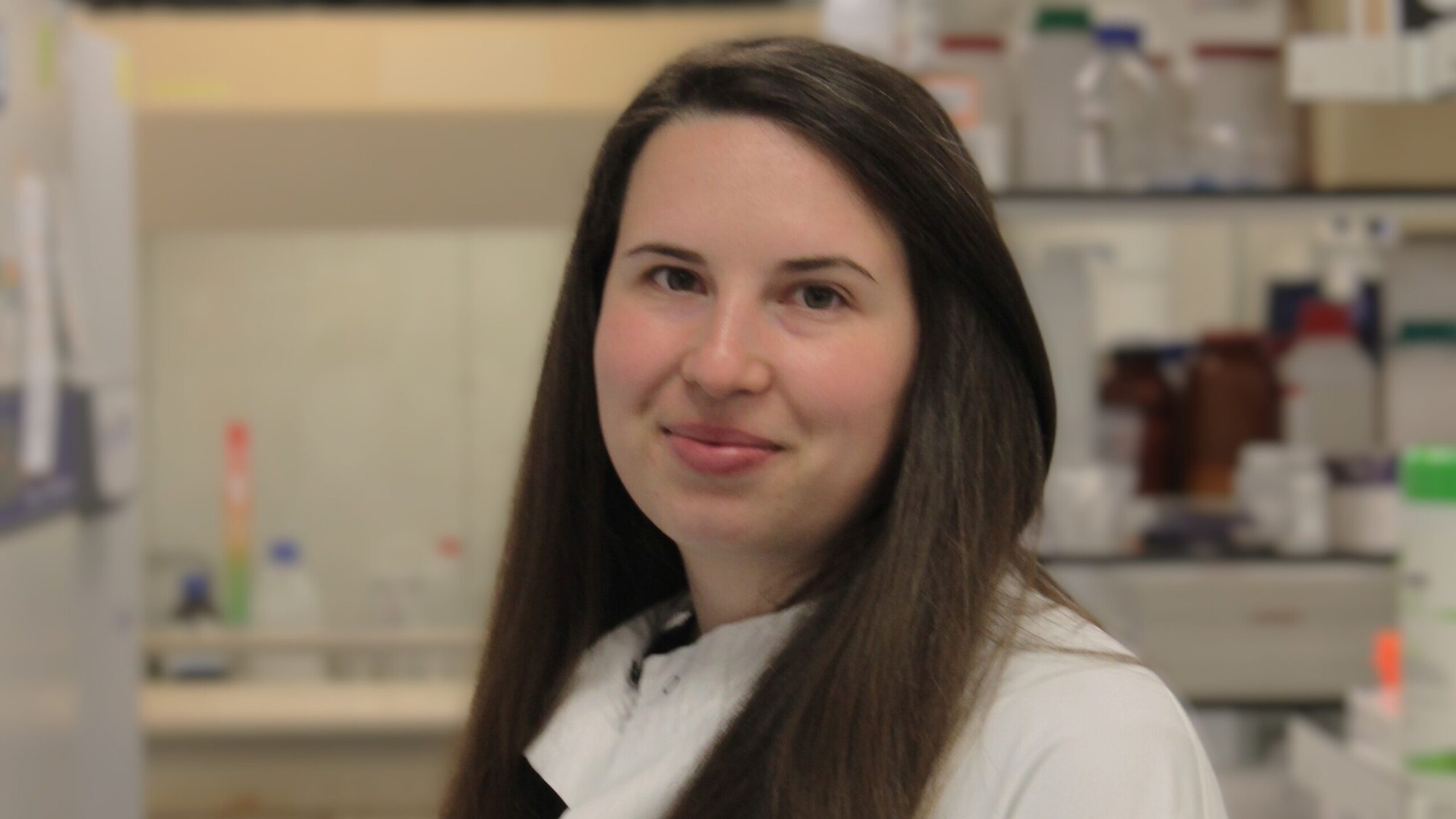
Meet a researcher: Gabriel Velichkova
Gabriel Velichkova is in the second year of her Retina UK and Macular Society joint-funded PhD project at University College London (UCL) Institute of Ophthalmology.
She is acquiring essential skills that will set her up for a future career as a research leader, while refining a cutting-edge genetic technique with huge potential to treat inherited retinal conditions.
“After gaining my MSci in genetics, I worked as a research technician, learning how to use a variety of techniques, including these amazing molecular scissors called CRISPR / Cas9 that allow us to snip out and correct specific bits of genetic code” Gabriel tells us. “This ignited my passion for genetic engineering, so I was really excited to undertake a PhD project focused on refining gene editing so that it might one day become a treatment with real impact for people with inherited sight loss.”
Gabriel is working on Stargardt disease, caused by faults in the ABCA4 gene that result in the accumulation of toxins in retinal cells and loss of central vision. One approach to treatment might be to provide healthy copies of ABCA4, so called ‘gene replacement therapy’, but this comes with a significant challenge.
“The problem we have is that ABCA4 is absolutely massive” Gabriel explains. “It won’t fit inside the harmless viruses typically used for delivering gene replacement therapies. Researchers are looking at splitting it into smaller pieces for reassembly inside the retina, but as you can imagine, there are potential pitfalls.”
Gabriel is working with a relatively recent innovation called prime editing, which aims to permanently correct a genetic mutation, allowing the cell to produce healthy, functional protein from the corrected gene, thereby halting disease progression in the edited cells.
“A great advantage of the prime editing system is its precision” she says. “The original CRISPR / Cas9 approach involves breaking both strands of the DNA double helix, but there is a reasonably high risk of incorporating mistakes, or that bits of DNA will get lost. With prime editing, a guide molecule brings the prime editor to the exact DNA location you are targeting, snips just one of the strands, and then provides the template for correction of the DNA error. That limits the potential for mistakes at the target location. Another advantage of prime editing systems is that they can work in adult cells that have stopped dividing, like cells in the brain or retina.”
The aim of the project is to find the most efficient version of the prime editor, which will be tested in the laboratory in a disease relevant model: living, miniature models of the human retina called retinal organoids, which can be grown in the lab from cells derived directly from a patient.
Retinal organoids are small 3D structures that have all the cell types found in a human retina and that need to be handled with a lot of care. “A fully developed retinal organoid takes at least 220 days to develop; often they are grown for longer!” Gabriel tells us. “In addition, there are a huge number of technically demanding experiments to run because multiple different combinations need to be tested to maximise the efficiency of the correction. There are plenty of challenges along the way.” But Gabriel is driven to make a difference for those living with inherited sight loss. “As a child, I would sometimes close my eyes and imagine what life would be like without the ability to see. It was so scary, but then I could just open my eyes again. There are so many people who don’t have that option, and we need to put all the effort we can into supporting people and working towards disease prevention and treatments.”
Retina UK is able to fund projects like Gabriel’s thanks to the generosity of our supporters. Find out more about ways to support Retina UK.