
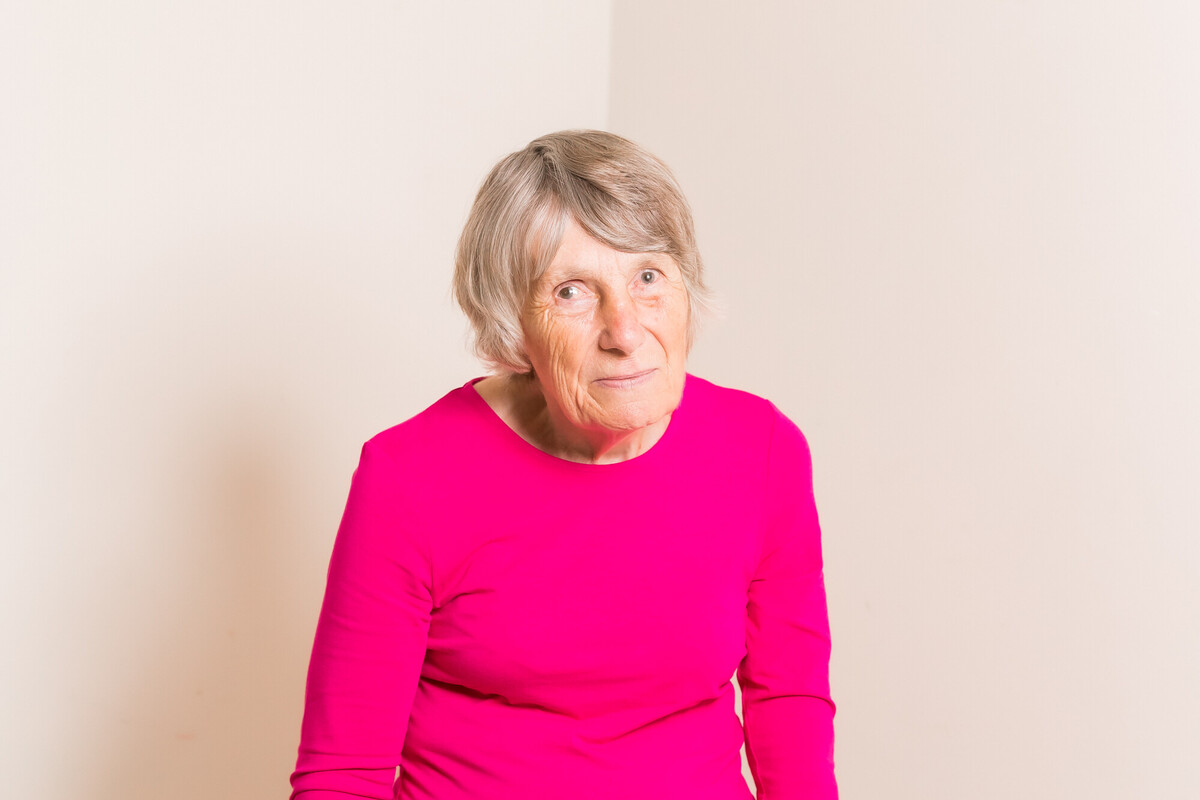
Meet our volunteers: Elizabeth Baio
Elizabeth first heard about Retina UK (then the British Retinitis Pigmentosa Society) when our founder, Lynda Cantor MBE, spoke on BBC In Touch in early 1977. She went along to the charity’s AGM the same year and stayed in touch with Mary Guest, one of the speakers.
Mary later invited her to join what became the National Welfare Committee along with the late Bob Gould and Stephen Goulden, who continues to volunteer for the charity to this day. Together they helped to set up the charity’s Helpline in the 1980s. When she retired after a career as a social worker in 2008, Elizabeth started volunteering on our telephone Helpline.
Elizabeth is living with retinitis pigmentosa (RP), she tells us: “I never had good vision and I couldn’t understand why other people could see in the dark because I wasn’t able to. I lost my central vision first and remember asking my father ‘when you look at Mummy, do you see her all at once’? The consultant told my mum that my condition was rare, that I wouldn’t be able to work and to just take me home!” There is no family history she is aware of and her own children and grandchildren are unaffected.
Elizabeth first experienced visual hallucinations, known as Charles Bonnet Syndrome (CBS) at the age of 13. She said “I was a teenager in the psychedelic 1960s, and people were taking and describing all sorts of hallucinogens. I had no knowledge of drugs at all and had never taken anything but felt I couldn’t say I was seeing things that weren’t there!
“I first heard about CBS in my 30s at work. One of my colleagues asked me if I had heard of something called Charles Bonnet Syndrome? She told me about a visually impaired lady who ‘keeps talking about these images that are just not there’ so we looked it up in the medical dictionary. I did meet one lady who had been sectioned under the Mental Health Act because she said there was a crowd of people in old fashioned dress with pitchforks walking up the street. That’s not uncommon.”
“Judith Potts from Esme’s Umbrella spoke at a Retina UK volunteer training weekend and at the end of her session, she asked if anyone had personal experience of CBS. It was then that I spoke about mine for the very first time.
“I met Dominic Fitch, an expert in this field, and attended several conferences about it. For a while, I took quite a few calls from the RNIB helpline about CBS. It grew because I’m interested and because so many people don’t talk about it. Bottling things up never helps.”
When asked about the future of the charity, 50 years on from its formation, she said: “My hope is that progress will be made in research. I’m aware they’re probably not going to be miraculous for most, but anything that can prolong useful vision would help. I also hope there is still support for people to have a good quality of life. Sharing fears and problems with someone with similar experience can be the first step towards finding your own way forward. Some people still don’t know about peer support groups, how useful it is to talk to others and how it can dispel some of the fear, loneliness and isolation they may feel.” Learn more about Retina UK Peer Support Groups.